Thursday, July 12, 2007

Once an English drinking song
It was once true that all people who were born in the United States of America, spoke English, after they were old enough. That is no longer correct. It has been estimated that 15 million citizens of Mexico, illegally immigrated into our county. Many have been here for years and still did not learn to speak English, our nation language. Lots of them have raised big families and most of their children have not learned to speak and understand English.

"I think people who want to be a citizen of this country ought to learn English and they ought to learn to sing the national anthem in English." Here's why . . .

When Francis Scott Key penned "The Star-Spangled Banner," he lifted the melody from an old English drinking song. When the tune was accepted as our national anthem, that must have provided ample barroom fodder across the pond. A couple of centuries later, Jimi Hendrix rocked Woodstock?”and the country?? with his stunning and brilliant guitar riff take on it. Roseanne Barr Arnold got booed out of the ballpark with her tongue-in-cheek off-key belted-out version. Over the years, various recording artists have created their versions of "The Star-Spangled Banner." With such a mottled background, why shouldn't our national anthem have a Spanish-language version? Why is that scary and threatening to so many Americans?

The melody of our national anthem is stirring, though dreadful to sing. And then there are the lyrics, which were a nationalistic inspiration from the last ravages of a war. If I could re-write history, I'd rather our national anthem be "America, the Beautiful".

Quote Theodore Roosevelt, 1907:
In the first place, we should insist that if the immigrant who comes here in good faith, becomes an American and assimilates himself to us, he shall be treated on an exact equality with everyone else for it is an outrage to discriminate against any such man because of creed, or birthplace, or origin. But this is predicated upon the person's becoming in every facet an American, and nothing but an American... There can be no divided allegiance here. Any man who says he is an American, but something else also, isn't an American at all. We have room for but one flag, the American flag... We have room for but one language here, and that is the English language... and we have room for but one sole loyalty and that is a loyalty to the American people."

Monday, July 9, 2007

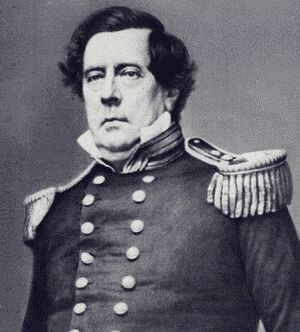
Matthew C. Perry
Matthew Calbraith Perry (April 10, 1794 - March 4, 1858) was the Commodore of the U.S. Navy who compelled the opening of Japan to the West with the Convention of Kanagawa in 1854.

Early life and naval career
Born in Rocky Brook, Rhode Island, he was the son of Captain Christopher R. Perry and the younger brother of Oliver Hazard Perry. Matthew Perry got a midshipman's commission in the Navy in 1809, and was initially assigned to Revenge under the command of his elder brother.

Commodore Perry's early career saw him assigned to several ships, including the President where he was aide to Commodore John Rodgers, which was in a victorious engagement over a British vessel, HMS Little Belt shortly before the War of 1812 was officially declared. During that war Perry was transferred to USS United States and as a result saw little fighting in that war afterward, since the ship was trapped at New London, Connecticut. After that war he served on various vessels in the Mediterranean and Africa (notably aboard USS Cyane during its patrol off Liberia in 1819-1820), sent to suppress piracy and the slave trade in the West Indies. Later during this period, while in port in Russia, Perry was offered a commission in the Russian navy, which he declined.

Command assignments, 1820s-1840s
Opening of Key West
Perry commanded the Shark from 1821-1825. When Britain possessed Florida in 1763, the Spanish contended that the Florida Keys were part of Cuba and North Havana. The United States felt that Key West (which was then named Cayo Hueso, which means "Bone Island") could potentially be the "Gibraltar of the West" because it guarded the northern edge of the 90 mile wide Straits of Florida -- the deep water route between the Atlantic and the Gulf of Mexico.
1815 the Spanish governor in Havana, Cuba deeded the island of Key West, Florida to Juan Pablo Salas of Saint Augustine, Florida. After Florida was transferred to the United States, Salas sold Key West to U.S. businessman John W. Simonton for $2,000 in 1821. Simonton lobbied the U.S. Government to establish a naval base on Key West, both to take advantage of its strategic location and to bring law and order to Key West town.

On March 25, 1822, Perry sailed the schooner Shark to Key West and planted the U.S. flag, physically claiming the Keys as United States property.
Perry renamed Cayo Hueso "Thompson's Island" for the Secretary of the Navy Smith Thompson and the harbor "Port Rodgers" for the president of the Board of Navy Commissioners. Neither name stuck.

From 1826-1827 Perry acted as fleet captain for Commodore Rodgers. Perry returned for shore duty to Charleston, South Carolina in 1828, and in 1830 took command of USS Concord He spent the years of 1833-1837 as second officer of the New York Navy Yard (later the Brooklyn Navy Yard), gaining promotion to captain at the end of this tour.

Father of the Steam Navy
Perry had a considerable interest in naval education, supporting an apprentice system to train new seamen, and helped establish the curriculum for the United States Naval Academy. He was also a vocal proponent of modernizing the Navy. Once promoted to captain, he oversaw construction of the Navy's second steam frigate, USS Fulton which he commanded after its completion. He was called "The Father of the Steam Navy", and he organized America's first corps of naval engineers, and conducted the first U.S. naval gunnery school while commanding Fulton in 1839-1840 off Sandy Hook on the coast of New Jersey.

Promotion to commodore
Perry acquired the courtesy title of Commodore in 1841, and was made chief of the New York Navy Yard in the same year. In 1843 he took command of the African Squadron, whose duty was to interdict the slave trade under the Webster-Ashburton Treaty, and continued in this endeavor through 1844.

The Mexican-American War
In 1845 Commodore David Connor's length of service in command of the Home Squadron had come to an end. However, the coming of the Mexican-American War persuaded the authorities not to change commanders in the face of the war. Perry, who would eventually succeed Connor, was made second-in-command and captained the USS Mississippi . Perry captured the Mexican city of Fronter, demonstrated against Tabasco and took part in the Tampico Expedition. He had to return to Norfolk, Virginia to make repairs and was still there when the amphibious landings at Vera Cruz took place. His return to the U.S. gave his superiors the chance to finally give him orders to succeed Commodore Connor in command of the Home Squadron. Perry returned to the fleet during the siege of Veracruz and his ship supported the siege from the sea. After the fall of Veracruz Winfield Scott moved inland and Perry moved against the remaining Mexican port cities. Perry assembled the Mosquito Fleet and captured Tuxpan in April, 1847. In July 1847 he attacked Tabasco personally, leading a 1173-man landing force ashore and attacked the city from land.

The Opening of Japan: 1852-1854
Precedents
Perry's expedition to Japan was preceded by several naval expeditions by American ships:

* From 1797 to 1809, several American ships traded in Nagasaki under the Dutch flag, upon the request of the Dutch, who were not able to send their own ships because of their conflict against Britain during the Napoleonic Wars. Trade was limited to the Dutch and Chinese at that time (sakoku).

* In 1837, an American businessman in Canton, named Charles W. King, saw an opportunity to open trade by trying to return to Japan three Japanese sailors (among them, Otokichi) who had been shipwrecked a few years before on the coast of Washington. He went to Uraga Channel with Morrison, an unarmed American merchant ship. The ship was attacked several times, and sailed back without completing its mission.

* In 1846, Commander James Biddle, sent by the United States Government to open trade, anchored in Tokyo Bay with two ships, including one warship armed with 72 cannons, but his requests for a trade agreement remained unsuccessful.

* In 1848, Captain James Glynn sailed to Nagasaki, leading at last to the first successful negotiation by an American with "Closed Country" Japan. James Glynn recommended to the United States Congress that negotiations to open Japan should be backed up by a demonstration of force, thus paving the way to Perry's expedition.

First visit, 1852-1853
In 1852, Perry embarked from Norfolk, Virginia for Japan, in command of a squadron in search of a Japanese trade treaty. Aboard a black-hulled steam frigate, he ported Mississippi Plymouth Saratoga and Susquehanna at Uraga Harbor near Edo (modern Tokyo) on July 8, 1853, and was met by representatives of the Tokugawa Shogunate who told him to proceed to Nagasaki, where there was limited trade with the Netherlands and which was the only Japanese port open to foreigners at that time (see Sakoku). Perry refused to leave and demanded permission to present a letter from President Millard Fillmore, threatening force if he was denied. The Japanese military forces could not resist Perry's modern weaponry; the "Black Ships" would then become, in Japan, a threatening symbol of Western technology.

The Japanese government let Perry come ashore to avoid a naval bombardment. Perry landed at Kurihama (in modern-day Yokosuka) on July 14, presented the letter to delegates present, and left for the Chinese coast, promising to return for a reply.

Second visit, 1854
Perry returned in February 1854 with twice as many ships, finding that the delegates had prepared a treaty embodying virtually all the demands in Fillmore's letter. Perry signed the Convention of Kanagawa on March 31, 1854 and departed, mistakenly believing the agreement had been made with imperia representatives.

On his way to Japan, Perry anchored off of Keelung in Formosa, known today as Taiwan, for ten days. Perry and crew members landed on Formosa and investigated the potential of mining the coal deposits in that area. He emphasized in his reports that Formosa provided a convenient mid-way trade location. Formosa was also very defensible. It could serve as a base for exploration like Cuba had done for the Spanish in the Americas. Occupying Formosa could help the US to counter European monopolization of the major trade routes. The United States government did not respond to Perry's proposal to claim sovereignty over Formosa.

Return to the United States, 1855
When Perry returned to the United States in 1855, Congress voted to grant him a reward of $20,000 in appreciation of his work in Japan. Perry used part of this money to prepare and publish a report on the expedition in three volumes, titled Narrative of the Expedition of an American Squadron to the China Seas,and Japan. He was also advanced to the grade of rear-admiral on the retired list (when his health began to fail) as a reward for his services in the Far East.

Last years
Perry died on March 4, 1858 in New York City, of liver cirrhosis due to alcoholism. His remains were moved to the Island Cemetery in Newport, Rhode Island on March 21, 1866, along with those of his daughter, Anna, who died in 1839.


Friday, July 6, 2007

John C. Frémont - Pathfinder
John Charles Frémont (January 21, 1813 - July 13, 1890, was an American military officer, explorer, the first candidate of the Republican Party for the office of President of the United States, and the first Presidential candidate of a major party to run on a platform in opposition to slavery. During the 1840s, that era's penny press accorded Frémont the epithet The Pathfinder, which remains in use, sometimes as "The Great Pathfinder".
Biography
Frémont was born in Savannah, Georgia. His ancestry is disputed by historians. According to the 1902 genealogy of the Frémont family, he was the son of Anne Beverley Whiting, a prominent Virginia society woman, who after his birth, married Louis-René Frémont, a penniless French refugee, in Norfolk on May 14, 1807. Louis-René Frémont was the son of Jean-Louis Frémont, a Québec City merchant, who was the immigrant son of Charles-Louis Frémont from Saint Germain en Laye near Paris. H.W. Brands, however, in his biography of Andrew Jackson, states that Fremont was the son of Anne and Charles Fremon, and that Fremont added the accented "e" and the "t" to his name later in life. Many confirm he was in fact illegitimate, a social handicap he overcame by marrying Jessie Benton, the favorite daughter of the very influential senator and slave owner from Missoui, Thomas Hart Benton (1782-1858).

Benton, Democratic Party leader for over 30 years in the Senate, championed the expansionist movement, a political cause that became known as "Manifest Destiny." The expansionists believed that the North American continent, from one end to the other, should belong to the citizens of the United States, and that getting those lands was the country’s destiny. This movement became a crusade for politicians like Benton, and in his new son-in-law, making a name for himself as a western topographer, he saw in Frémont a great political asset. Benton was soon pushing through Congress appropriations of money to be used for surveys of the Oregon Trail (1842), Oregon Territory (1844), and the Great Basin and Sierra Mountains to California (1845). Through his power and influence, Benton got Frémont the leadership of these expeditions.

Frémont's great-grandfather, Henry Whiting, was a half-brother of Catherine Whiting who married John Washington, uncle of George Washington.
Expeditions
Frémont assisted and led multiple surveying expeditions through the western territory of the United States. In 1838 and 1839 he assisted Joseph Nicollet in exploring the lands between the Mississippi and Missouri Rivers, and in 1841, with training from Nicollet, he mapped portions of the Des Moines River.
Frémont first met American frontiersman Kit Carson on a Missouri River steamboat in St. Louis, Missouri during the summer of 1842. Frémont was preparing to lead his first expedition and was looking for a guide to take him to South Pass. The two men made acquaintance, and Carson offered his services, as he had spent much time in the area. The five-month journey, made with 25 men, was a success, and Fremont's report was published by the U.S. Congress. The Frémont report "touched off a wave of wagon caravans filled with hopeful emigrants" heading west.

From 1842 to 1846, Frémont and his guide Carson led expedition parties on the Oregon Trail and into the Sierra Nevada. During his expeditions in the Sierra Nevada, it is generally acknowledged that Frémont became the first European American to view Lake Tahoe. He is also credited with determining that the Great Basin had no outlet to the sea. He also mapped volcanoes such as Mount St. Helens.
Third expedition
On June 1, 1845 John Frémont and 55 men left St. Louis, with Carson as guide, on the third expedition. The stated goal was to "map the source of the Arkansas River", on the east side of the Rocky Mountains. But upon reaching the Arkansas, Frémont suddenly made a hasty trail straight to California, without explanation. Arriving in the Sacramento Valley in early winter 1846, he promptly sought to stir up patriotic enthusiasm among the American settlers there. He promised that if war with Mexico started, his military force would "be there to protect them." Frémont nearly provoked a battle with General José Castro near Monterey, which would have likely resulted in the annilation of Frémont's group, due to the superior numbers of the Mexican troops. Frémont then fled Mexican-controlled California, and went north to Oregon, finding camp at Klamath Lake.
Following a May 9, 1846, Modoc Indian attack on his expedition party, Frémont chose to attack a Klamath Indian fishing village named Dokdokwas, at the junction of the Williamson River and Klamath Lake, which took place May 10, 1846. The action completely destroyed the village, and involved the massacre of women and children. After the burning of the village, Carson was nearly killed by a Klamath warrior later that day: his gun misfired, and the warrior drew to fire a poison arrow; but Frémont, seeing Carson's predicament, trampled the warrior with his horse. Carson stated felt that he owed Frémont his life due to this incident.

On June 28, 1846, Frémont intercepted three Mexican men crossing the San Francisco Bay and landing near San Quentin. Frémont provided Carson with indirect and ambiguous orders to execute the three men in revenge for the deaths of the two Americans. Carson questioned the orders. At first he asked Fremont if he should take the men prisoner. Frémont's plan was otherwise: "I have no use for prisoners, do your duty," was the response. When Carson hesitated Frémont yelled, "Mr. Carson, your duty," to which Carson then complied by executing Jose R. Berreyesa and his newphews, Ramon and Fransciso De Haro, the nineteen-year-old twin sons of Francisco De Haro, the first Alcalde of San Francisco, near present-day San Rafael. The execution of these popular Californianos hindered Frémont's political career and prevented him from being the first American governor of California, a post he coveted. Writing about the executions a half-century later, the historian Robert A. Thompsen noted, "Californians cannot speak of it down to this day without intense feeling."
Mexican-American War
In 1846, Frémont was also Lieutenant Colonel of the U.S. Mounted Rifles (a predecessor of the 3rd Armored Cavalry Regiment). In late 1846 Frémont, acting under orders from Commodore Robert F. Stockton, led a military expedition of 300 men to capture Santa Barbara, Californi, during the Mexican-American War. Frémont led his unit over the Santa Ynez Mountains at San Marcos Pass and captured the Presidio, and the town. Mexican General Pico, recognizing that the war was lost, later surrendered to him rather than incur casualties.
On January 16, 1847, Commodore Stockton appointed Frémont military governor of California following the Treaty of Cahuenga, which ended the Mexican-American War in California. However, U.S. Army general Stephen Watts Kearny, who outranked Frémont and believed that he was the legitimate governor, arrested Frémont and brought him to Washington, D.C. where he was convicted of mutiny. President James Polk quickly pardoned him in light of his service in the war.
U.S. Senator
Frémont served from 1850 to 1851 as one of the first pair of Senators from California. In 1856, the new Republican Party nominated him as their first presidential candidate. He lost to James Buchanan, though he did surpass the American Party candidate, Millard Fillmore. Frémont lost California in the Electoral College.

Civil War
Frémont later served as a major general in the American Civil War and served a controversial term as commander of the Army's Department of the West from May to November 1861.
Frémont replaced William S. Harney who had negotiated the Harney-Price Truce which permitted Missouri to remain neutral in the conflict as long as it did not send men or supplies to either side.

Frémont ordered his General Nathaniel Lyon to formally bring Missouri into the Union cause. Lyon had been named the temporary commander of the Department of the West to succeed Harney before Frémont ultimately replaced Lyon. Lyon, in a series of battles, evicted Governor Claiborne Jackson and installed a pro-Union government. After Lyon was killed in the Battle of Wilson's Creek in August, Frémont imposed martial law in the state, confiscating private property of secessionists and emancipating the state's slaves.

Abraham Lincoln, fearing the order would tip Missouri (and other slave states in Union control) to the southern cause, asked Frémont to revise the order. Frémont refused and sent his wife to plead the case. Lincoln responded by revoking the proclamation and relieving Frémont of command on November 2, 1861. In March 1862, Frémont was re-appointed to a different post (in West Virginia), but lost several battles to Stonewall Jackson and was relieved at his own request when ordered to serve under General John Pope.

Frémont took on the thirteen-year-old Jesse Shepard as his page, a role he filled for two years, until 1863. It is claimed that he chose Jesse to be his page for a love relationship because the boy was queer, and the two were constantly together, the boy displaying a great affection for Frémont.
Radical Republicans
Frémont was briefly the 1864 candidate of the Radical Republicans, a group of hard-line Republican abolitionists upset with Lincoln's position toward both the issues of slavery and post-war reconciliation with the southern states. This 1864 fracturing of the Republican Party splintered off into two new political parties: the anti-Lincoln Radical Republicans (convening in Cleveland starting on May 31, 1864) nominating Frémont, the Republicans' first standard-bearer from 1856, and; the political collaboration between pro-Lincoln Republicans and Democrats to form a new National Union Party (in convention in Baltimore during the first week in June 1864 Presidential Election) in order to accommodate War Democrats who wished to separate themselves from the Copperheads.

Coincidentally, this creation of the National Union Party is the main reason why War Democrat Andrew Johnson was selected to be the Vice Presidential nominee. The former republicans who supported Lincoln also hoped that the new party would stress the national character of the war.

The Frémont-Radical Republicans political campaign was abandoned in September 1864 immediately after Frémont brokered a political deal with National Union Party candidate Lincoln to remove U.S. Posmaster General Montgomery Blair from his appointed federal office.
Later life
The state of Missouri took possession of the Pacific Railroad in February 1866 when the company defaulted in its interest payment, and in June 1866, the state, at private sale, sold the road to Frémont. Frémont reorganized the assets of the Pacific Railroad as the Southwest Pacific Railroad in August 1866, which in less than a year (June 1867) were repossessed by the state of Missouri when Frémont was unable to pay the second installment on his purchase price.
From 1878 to 1881, Frémont was the appointed governor of the Arizona Territory. The family eventually had to live off the publication earnings of wife Jessie. Frémont died in 1890 a forgotten man, of peritonitis in a hotel in New York City and is buried in Rockland Cemetery, Sparkill, New York.
Legacy
Frémont collected a number of plants on his expeditions, including the first recorded discovery of the Single-leaf Pinyon by a European American. The standard botanical author abbreviation Frém. is applied to plants he described. The California Flannelbush, Fremontodendron californicum, is named for him.
Many places are named for Frémont. Four U.S. states named counties in his honor: Colorado, Idaho, Iowa, and Wyoming. Several states also named cities after him, such as California, Michigan, Nebraska, and New Hampshire. Likewise, Fremont Peak in the Wind River Mountains and Fremont Peak in Monterey County, California are also named for the explorer. The Fremont River, a tributary of the Colorado River in southern Utah, was named after Frémont, and in turn, the prehistoric Fremont culture was named after the river—the first archaeological sites of this culture were discovered near its course.
A barbershop chorus in Fremont, Nebraska is named The Fremont Pathfinders in homage to the explorer, as is the Fremont Pathfinders Artillery Battery, an American Civil War reenactment group from the same community.

Fremont Street in Las Vegas, Nevada is named in his honor, as are streets in Minneapolis, Minnesota, Kiel, Wisconsin, Manhattan, Kansas, Portland, Oregon, the California cities of Monterey, Seaside, Stockton and San Francisco, and the Grant City section of Staten Island, New York. Portland also has several other locations named after Frémont, such as Fremont Bridge. Other places named for him include John C. Fremont Senior High School in Los Angeles and Oakland, California and the John C. Fremont Branch Library, located on Melrose Avenue in Los Angeles, California, and a John C. Fremont Junior High School in Mesa, Arizona, and one in Oxnard, California. Fremont High School in Sunnyvale, California is named for the explorer and its annual yearbook is called The Pathfinder. In addition, the John C. Fremont Hospital, in Mariposa, California-where Fremont and his wife lived and prospered during the Gold Rush is named for him.

In James Michener's novel Space, much of the action occurs in the fictional state of "Frémont", and several of the novel's main characters are natives of this state. The novel's endpapers include a map of the United States that shows the precise borders of Michener's fictional Frémont, but necessarily omits the borders of the neighboring states. The fictional Frémont's location roughly corresponds to our world's Nebraska.

The U.S. Army's (now inactive) 8th Infantry Division (Mechanized) is called the Pathfinder Division, after John Frémont. The gold arrow on the 8th ID crest is called the "Arrow of General Frémont."

Sunday, July 1, 2007

GENERAL ROY STANLEY GEIGER, USMC
NOAH'S NOTE: I served in the Corps under General Geiger's command while in the assault and capture of the southern Palau islands and while he commanded the Marine Corps III Amphibious Corps in the battle for the island of Okinawa. I was very close to the 10th Army Commanding Officer, General Simon Buckner, when he was killed.
<> <> <>
General Geiger commanded both air and ground units during World War II, and was the first Marine to lead a United States Army.

General Geiger commanded the III Amphibious Corps in the battle for Okinawa where upon the death in action of Lieutenant General Simon Bolivar Buckner, Commanding General of the Tenth Army, General Geiger assumed command and led the Tenth Army to the successful conclusion of World War II's final campaign.

For his part in this action he was awarded the Distinguished Service Medal (Army). His citation reads in part, "Going ashore with the early landing elements on 1 April 1945, he began a bitter three-month campaign…with outstanding professional skill, forceful leadership and unswerving determination, he directed his units…repeatedly disregarding personal safety to secure a first hand estimate of the battle situation and inspiring his men to heights of bravery and accomplishment."

General Geiger was born on 25 January 1885, in Middleburg, Florida. He attended Florida State Normal and received an LLB from Stetson University, following which he enlisted in the Marine Corps on 2 November 1907. He was commissioned a Second Lieutenant on 5 February 1909.

Following attendance at the Marine Officers' School at Port Royal, South Carolina, he served as a member of the Marine Detachments aboard the USS Wisconsin and the USS Delaware. In August 1912, he went to foreign shore duty in Nicaragua and while in that country participated in the bombardment, assault and capture of Coyotepe and Barranca. Further foreign shore duty followed in the Philippines and China with the First Brigade and with the Marine Detachment, American Legation, Peking, China, from 1913 to 1916.

In March 1916, General Geiger joined the Naval Aeronautic Station at Pensacola, Florida, as a student naval aviator. He successfully completed the course and became the Marine Corps' fifth aviator in June 1917.

Further training followed and in July 1918, he arrived in France. He served with Group Number Five, Royal Air Forces at Dunkerque. He commanded a squadron of the First Marine Aviation Force and was attached to the Day Wing, Northern Bombing Group. He was detached to the United States in January 1919. For distinguished service in leading bombing raids against the enemy, he was awarded the Navy Cross.

From December 1919 to January 1921, he was a squadron commander with the Marine Aviation Force attached to the First Provisional Brigade in Haiti. Upon return to the United States and after duty at the Marine Flying Field, Marine Barracks, Quantico, Virginia, he attended Command and General Staff School at Fort Leavenworth, Kansas. He graduated in June 1925. Again he went to foreign shore duty, commanding Observation Squadron Two with the First Brigade in Haiti.

In August 1927, he returned to Quantico as a squadron officer and instructor at the Marine Corps Schools, and in May 1928, was assigned to duty in the Aviation Section, Division of Operations and Training, at Headquarters Marine Corps. After attending the Army War College and graduating in June 1929, he was ordered to Quantico, where he was assigned duty as Commanding Officer, Aircraft Squadrons, East Coast Expeditionary Force. He returned to Washington for duty with Aeronautics, Navy Department as Officer in Charge, Marine Corps Aviation.

In June 1935, he returned to Quantico as Commanding Officer, Aircraft One, Fleet Marine Force. From June 1939 to March 1941, he was a student at the Senior and the Advanced Courses, Naval War College, Newport, Rhode Island. This was followed with a brief tour of duty in the Office of the Naval Attache, London, England. In August 1941, he became Commanding General, 1st Marine Aircraft Wing, Fleet Marine Force, in which capacity he was found upon this country's entry into World War II.

He led the 1st Marine Aircraft Wing from 3 September to 4 November 1942, while stationed at Guadalcanal. For extraordinary heroism in this capacity as well as commander of all aircraft, he was awarded a Gold Star in lieu of a second Navy Cross. His citation reads in part, "Despite almost continuous bombardment by enemy aircraft, hostile naval gunfire and shore based artillery, the combined total of Army, Navy and Marine Corps units stationed at Guadalcanal under Major General Geiger's efficiently coordinated command succeeded in shooting down 268 Japanese planes in aerial combat and inflicting damage on a number estimated to be as great…Sank six enemy vessels, including one heavy cruiser, possibly sank three destroyers and one heavy cruiser, and damaged 18 other ships, including one heavy cruiser and five light cruisers."

He was recalled to Headquarters Marine Corps in May 1943, to become Director of Aviation. In November 1943, he returned to the field, this time as Commanding General of the I Amphibious Corps and led the Corps from 9 November to 15 December 1943, in the Bouganville Operation, for which he was awarded the Distinguished Service Medal.

Redesignated III Amphibious Corps in April 1944, he led this organization in the invasion and subsequent recapture of Guam during July and August, 1944, and in the assault and capture of the southern Palau Islands in September and October of the same year. For those operations he was awarded two Gold Stars in lieu of a second and third Distinguished Service Medal.

General Geiger led this Corps into action for the fourth time as part of the Tenth Army in the invasion and capture of Okinawa. In July 1945, he assumed duties as Commanding General of the Fleet Marine Force, Pacific, which position he held until called back to Headquarters Marine Corps in November, 1946.

In addition to the Navy Cross with Gold Star and the Distinguished Service Medal with two Gold Stars, his decorations and medals include the Distinguished Service Medal (Army) Okinawa; Presidential Unit Citation, Guadalcanal, 1942; Nicaraguan Campaign Medal, Nicaragua, 1912; Expeditionary Medal with two Bronze Stars, Nicaragua 1912, China 1914, Haiti 1919 and 1929; Victory Medal with Ypres Lys Clasp, France 1918; Haitian Campaign Medal, Haiti 1919 and 1920; Second Nicaraguan Campaign Medal, Nicaragua 1931; American Defense Service Medal; Asiatic-Pacific Campaign Medal; American Campaign Medal; World War II Victory Medal; Dominican Medal of Military Merit; Nicaraguan Medal of Distinction and Diploma.

A United States Marine Training Base was named to honor General Geiger. Although Camp Geiger is not geographically connected, Camp Geiger, along with Marine Corps Air Station (MCAS) New River, is part of the Marine Corps Base Camp Lejeune complex in North Carolnia, and is home to the Marine Corps Schools of Infantry for all Marines recruited through the Eastern Recruiting Region. Located off US Highway 17 about 10 miles south of Camp Lejeune. It training grounds for approximately 20,000 Marines every year.

General Geiger was promoted to four-star rank posthumously by the 80th Congress to be effective from 23 January 1947.