Friday, March 1, 2013
SUNDAY - March 17 Celebrated in NYC this
year on Saturday <> March 16
"On the streets of New York since 1762 - the oldest, largest, and best in the world" The parade marches up 5th Avenue, clan by clan. The Parade starts at 44th Street at 11 am and is held every March 17th, except when March 17th falls on a Sunday, it is celebrated the day before, Saturday the 16th because of religious observances.
The parade marches up Fifth Avenue past St. Patrick's Cathedral at 50th Street all the way up past the American Irish Historical Society at 83rd and the Metropolitan Museum of Art at 83rd Street to 86th Street, where the parade finishes around 4:30 - 5:00 pm
"The St. Patrick's Day Parade is one of New York City's greatest traditions. On this day, everyone is Irish in the Big Apple!
The Parade marched for the first time on March 17, 1762 - fourteen Years before the Declaration of Independence was adopted and today it is the largest Parade in the World.
This annual parade has been held for the past 247 years in honor of the Patron Saint of Ireland and the Archdiocese of New York. The Parade is reviewed from the steps of Saint Patrick's Cathedral by His Eminence Cardinal Edward Eagan, Archbishop of New York in the same manner as the Archbishop of New York did in the early days of the Parade at the Old St. Patrick's Cathedral in Lower Manhattan when the Parade was held in Lower Manhattan before the new St Patrick’s was built on Fifth Avenue.
Often regarded as the most popular parade in New York City, the Parade is the largest and most famous of the many parades held in the city each year."
Tuesday, February 26, 2013
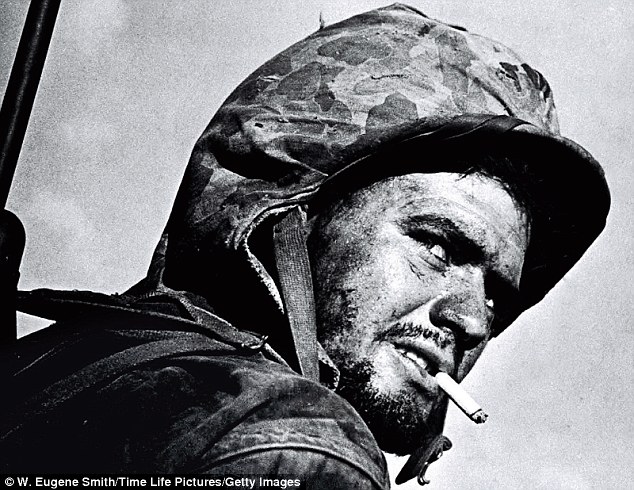
A few gung ho U.S. Marines
The 5th Regiment of the Marine Corps was activated on June 8, 1917, in Philadelphia, Pennsylvania. They immediately deployed to France and were assigned to the 1st Infantry Division of the United States Army. Later that year, in October, they were reassigned to 4th Brigade of Marines under the 2nd Infantry Division.
In spring the regiment was involved in the fierce battle of Belleau Wood, gaining the respect even of the hardened German veteran front troops.
The Fifth subsequently participated in the offensive campaigns at Aisne, Battle of Saint-Mihiel and in the Meuse-Argonne offensive. They also participated in the defensive campaigns at Toulon-Troyon, Chвteau-Thierry, Marbache and Limey. From 1918 until 1919 the regiment participated in the occupation of the German Rhineland. In August 1919 they relocated back to Marine Corps Base Quantico, Virginia. They were deactivated on August 13, 1919.
The regiment's actions in France earned them the right to wear the Fourragиre (seen in the outline of the unit's logo), one of only two in the Marine Corps (the other being the 6th Marine Regiment). The award was a result of being the only regiments in the American Expeditionary Force to receive three Croix de guerre citations: two in the order of the army and one in the order of the corps?Fourragиre and Croix de guerre with two Palms and Gilt Star. The Fourragиre became part of the uniform of the unit, and all members of the organization are authorized to wear the decoration on the left shoulder of the uniform as long as they remain members of the organization.
Three Marines of the regiment were awarded the Medal of Honor for their actions during the war. Sergeant Louis Cukela, Gunnery Sergeant Ernest A. Janson, and Sergeant Matej Kocak each received two Medals of Honor (one from the Navy and one from the Army) for a single action, making them three of only nineteen double recipients of the medal. In addition, two U.S. Navy officers attached the 5th Marines received the Medal of Honor: Lieutenant Commander Alexander Gordon Lyle of the Navy Dental Corps and Lieutenant Orlando H. Petty of the Medical Corps.
Tuesday, February 12, 2013
Clinton L. Romesha, Staff Sgt. United States Army
Medal of Honor recipient
Staff Sergeant Clinton L. Romesha distinguished himself by acts of gallantry and intrepidity at the risk of his life above and beyond the call of duty while serving as a Section Leader with Bravo Troop, 3d Squadron, 61st Cavalry Regiment, 4th Brigade Combat Team, 4th Infantry Division, during combat operations against an armed enemy at Combat Outpost Keating, Kamdesh District, Nuristan Province, Afghanistan on October 3, 2009.
On that morning, Staff Sergeant Romesha and his comrades awakened to an attack by an estimated 300 enemy fighters occupying the high ground on all four sides of the complex, employing concentrated fire from recoilless rifles, rocket propelled grenades, anti-aircraft machine guns, mortars and small arms fire.
Staff Sergeant Romesha moved uncovered under intense enemy fire to conduct a reconnaissance of the battlefield and seek reinforcements from the barracks before returning to action with the support of an assistant gunner.
Staff Sergeant Romesha took out an enemy machine gun team and, while engaging a second, the generator he was using for cover was struck by a rocket-propelled grenade, inflicting him with shrapnel wounds.
Undeterred by his injuries, Staff Sergeant Romesha continued to fight and upon the arrival of another soldier to aid him and the assistant gunner, he again rushed through the exposed avenue to assemble additional soldiers.
Staff Sergeant Romesha then mobilized a five-man team and returned to the fight equipped with a sniper rifle. With complete disregard for his own safety, Staff Sergeant Romesha continually exposed himself to heavy enemy fire, as he moved confidently about the battlefield engaging and destroying multiple enemy targets, including three Taliban fighters who had breached the combat outpost’s perimeter.
While orchestrating a successful plan to secure and reinforce key points of the battlefield, Staff Sergeant Romesha maintained radio communication with the tactical operations center. As the enemy forces attacked with even greater ferocity, unleashing a barrage of rocket-propelled grenades and recoilless rifle rounds, Staff Sergeant Romesha identified the point of attack and directed air support to destroy over 30 enemy fighters.
After receiving reports that seriously injured Soldiers were at a distant battle position, Staff Sergeant Romesha and his team provided covering fire to allow the injured Soldiers to safely reach the aid station.
Upon receipt of orders to proceed to the next objective, his team pushed forward 100 meters under overwhelming enemy fire to recover and prevent the enemy fighters from taking the bodies of their fallen comrades. Staff Sergeant Romesha’s heroic actions throughout the day-long battle were critical in suppressing an enemy that had far greater numbers. His extraordinary efforts gave Bravo Troop the opportunity to regroup, reorganize and prepare for the counterattack that allowed the Troop to account for its personnel and secure Combat Outpost Keating.
Staff Sergeant Romesha’s discipline and extraordinary heroism above and beyond the call of duty reflect great credit upon himself, Bravo Troop, 3d Squadron, 61st Cavalry Regiment, 4th Brigade Combat Team, 4th Infantry Division and the United States Army.
Tuesday, January 8, 2013
Colonel - USMC
In 1945, Lt. Colonel Walter Walsh was my commanding officer in combat on the island of Okinawa and later North China, while serving with the First Marine Division. Walsh could often be seen on the frontline with his weapon blazing as if he was one of us. This very brave officer did not waste ammunition. Each round he fired, a dead Japanese would fall. On one occasion, Walsh picked up a Japanese rifle after killing the Jap, and at a later time, he asked me to have it mailed to his former boss, FBI Director J. Edgar Hoover.
Colonel Walter Rudolph Walsh (born May 4, 1907) is a former FBI agent, USMC shooting instructor and Olympic shooter. Walsh joined the FBI in 1934, serving during the Public enemy era, and was involved in several high-profile FBI cases, including the capture of Arthur Barker and the killing of Al Brady. He served in the Pacific theatre during World War II with the Marine Corps and, after a brief return to the FBI, served as a shooting instructor with the Marine Corps until his retirement in the 1970s
A high profile shooter, Walsh won numerous tournaments within the FBI and the Marine Corps, as well as nationally, and participated in the 1948 Summer Olympics. He received awards for his marksmanship until the age of 90 and served as the coach of the Olympic shooting team until 2000. At the FBI's 100th anniversary celebration he was recognized as the oldest living former agent and noted as being a year older than the organization itself. Aside from some hearing and memory loss, he remained physically fit at his 105th birthday.
Early life and FBI career
Walsh was born in Union City, New Jersey. He joined the Civilian Military Training Corps at age 16, and the New Jersey Army National Guard in 1928.
After graduating from Rutgers Law School, Walsh joined the Federal Bureau of Investigation in 1934. Later that year, he discovered the body of gangster Baby Face Nelson, who died of injuries sustained in a gun battle with the police in Barrington, Illinois on November 27, 1934. Nelson had killed two FBI agents prior to fleeing the scene, wounded, and later died at his wife's side. The FBI, unaware of Nelson's death, continued a broad search for him, which included several home raids, through the night and into the following day. The search was not called off until a tip led them to Nelson's body, which was lying in a ditch in what is now Skokie, Illinois.
Walsh was on the team that captured criminal Arthur Barker, son of gangster Ma Barker, in Chicago in 1935 and was later involved in tracking Public Enemy Number One Al Brady in 1937. On October 12 of that year, he was with the group of FBI agents who ambushed and killed Brady in a shoot-out at a Bangor, Maine sporting goods store. While waiting for Brady to arrive, he acted as a clerk in the store for several days and arrested Brady Gang member James Dalhover. As the operation leader, Walsh's job was to alert thirteen other agents, as well as over 30 other state and local policemen, of any gang member's arrival by pulling a cord on the window. As they were interrogating Dalhover in the story Clarence Lee Shaffer, Jr., another gang member, entered the building and began firing at the agents. While arresting Dalhover, Walsh took bullets to his hand, shoulder and right chest, but quickly returned to work.
Walsh was employed with the FBI until 1942 when, as a Reserve Marine Lieutenant, he took a leave to serve with the United States Marine Corps during World War II. After he left, Hoover refused to allow any more active agents to be members of any military reserve. He fought in the Pacific Theater, specifically on Okinawa and in North China. In one incident, he and his comrades were pinned down by a sniper, which Walsh was able to kill from 90 yards away with a single shot to the torso from a M1911 pistol. He earned the rank of Colonel and returned to the FBI for two years from 19461947. In total, during his tenure with the agency, he killed between 11 and 17 bandits.
Shooting and the Olympics
Walsh got his start with firearms shooting clothespins off of his aunt's laundry line. In 1935 he joined the FBI pistol team. Within three years of joining the FBI, he had been presented with two marksmanship trophies from director J. Edgar Hoover. In 1939, at Camp Ritchie, he set the world record in pistol shooting with 198 points out of a possible 200 and won the individual eastern regional pistol championships in 1939 and 1940 and placing second in 1941 after leading for most of the tournament. He placed 12th in the Men's Free Pistol, 50 metres competition at the 1948 Summer Olympics in London, England. At the 1952 ISSF World Shooting Championships, he won a gold medal with the United States team in the 25 m Center-Fire Pistol event and a silver in the individual version of that event. After winning many tournaments within the United States Marine Corps, he became commander of their marksmanship training, a position that he held for many years, until he retired in the 1970s. In total, he was selected five times for the All-American Pistol Shooting Team.
Later life
Walsh had three daughters, two sons and several grandchildren. As late as 1997, he was still receiving awards for his marksmanship, winning the Outstanding American Handgunner of the Year. Until 2000 he served as a coach for the Olympic shooting team, able to see without the aid of glasses even at the age of 92. At the age of 100 he was present at a re-enactment of the Al Brady shoot out in Bangor, Maine. At this event, he was presented with a plaque and the key to the city. At the age of 101, he was the FBI's oldest living former agent and was in excellent physical shape, aside from some hearing and memory loss. He credits his longevity to luck, listening to his parents, and blessings from God. At the 100th anniversary celebration of the FBI, it was noted that Walsh was older than the agency itself. He celebrated his 103rd birthday in 2010 and was still able to use the stairs in his three-story home in Arlington County, Virginia.
Subscribe to:
Posts (Atom)