Alexander A. Vandegrift
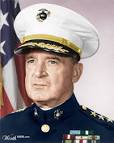
General Alexander Archer Vandegrift, who earned the Medal of Honor in World War II, served as the eighteenth
Commandant of the Marine Corps, from January 1, 1944 to January 1, 1948. The
general commanded the First Marine Division, Reinforced, in the battle for
Guadalcanal, and the First Marine Amphibious Corps in the landing at Empress
Augusta Bay, Bougainville, during World War II.
For outstanding services as Commanding General of the First Marine
Division, Reinforced, during the attack on Guadalcanal, Tulagi, and Gavutu in
the Solomon Islands on August 7, 1942, he was awarded the Navy Cross, and for
the subsequent occupation and defense from August 7 to December 9, 1942, was
awarded the Medal of Honor. His citation for the latter reads in part:
"With the adverse factors of weather, terrain and disease making his task
a difficult and hazardous undertaking, and with his command eventually including
sea, land, and air forces of the Army, Navy, and Marine Corps, Major General
Vandegrift achieved marked success in commanding the initial landings of the
United States Forces in the Solomon Islands and in their subsequent
occupation.
"His tenacity, courage and resourcefulness prevailed against a strong,
determined and experienced enemy, and the gallant fighting spirit of the men
under his inspiring leadership enabled them to withstand aerial, land and sea
bombardment, to surmount all obstacles and leave a disorganized and ravaged
enemy.
"This dangerous but vital mission, accomplished at the constant risk of
his life, resulted in securing a valuable base for further operations of our
forces against the enemy."
General Vandegrift was born on March 13, 1887, in Charlottesville,
Virginia. He attended the University of Virginia and was commissioned in the
Marine Corps as a second lieutenant on January 22, 1909.
Following instruction as the Marine Officers' School, Port Royal, South
Carolina, and a tour of duty at the Marine Barracks, Portsmouth, New Hampshire,
he went to foreign shore duty in the Caribbean area, where he participated in
the bombardment, assault and capture of Coyotepe in Nicaragua. He further
participated in the engagement and occupation of Vera Cruz, Mexico.
In December 1914, following his promotion to first lieutenant, he attended
the Advance Base Course at the Marine Barracks, Philadelphia. Upon completion of
schooling, he sailed for Haiti with the First Brigade and participated in action
against hostile Cacos bandits at LeTrou and Fort Capois.
In August 1916, he was promoted to captain and became a member of the
Haitian Constabulary at Port Au Prince, where he remained until detached to the
United States in December 1918. He returned to Haiti again in July 1919, to
serve with the Gendarmerie d' Haiti as an Inspector of Constabulary. He was
promoted to major in June 1920.
Major Vandegrift returned to this country in April 1923, and was assigned
to the Marine Barracks at Quantico, Virginia. He completed the Field Officers'
Course, Marine Corps Schools in May 1926, following which he went to the Marine
Corps Base, San Diego, California, as Assistant Chief of Staff.
In February 1927, he sailed for China where he served as Operations and
Training Officer of the Third Marine Brigade with Headquarters at Tientsin. He
was ordered to Washington, D. C., in September 1928, where he became Assistant
Chief Coordinator, Bureau of the Budget.
Following duty in Washington, he joined
the Marine Barracks, Quantico, Virginia, where he became Assistant Chief of
Staff, G-1 Section, Fleet Marine Force. During this assignment, he was promoted
to lieutenant colonel in June 1934. Ordered to China in June 1935, Lieutenant
Colonel Vandegrift served successively as Executive Officer and Commanding
Officer of the Marine Detachment at the American Embassy in Peiping. He was
promoted to colonel in September 1936.
Colonel Vandegrift reported to Headquarters Marine Corps, Washington, D.
C., in June 1937, where he became Military Secretary to the Major General
Commandant. In March 1940, he was appointed Assistant to the Major General
Commandant, and the following month was promoted to brigadier general.
General Vandegrift was detached to the First Marine Division in November
1941 shortly before the outbreak of World War II. He was promoted to major
general in March 1942, and in May sailed for the South Pacific area as
Commanding general of the first Marine division to ever leave the shores of the
United States. On August 7, 1942, in the Solomon Islands, he led ashore the
First Marine Division, Reinforced, in the first large-scale offensive action
against the Japanese.
In July 1943, he assumed command of the First Marine Amphibious Corps, and
commanded this organization in the landing at Empress Augusta Bay, Bougainville,
Northern Solomon Islands, on November 1, 1943. Upon establishing the initial
beachhead, he relinquished command and returned to Washington, D. C., as
Commandant-designate. On January 1, 1944, as a lieutenant general, he was sworn
in as the eighteenth Commandant of the Marine Corps. On April 4, 1945, he was
appointed general, with date of rank from March 21, 1945, the first Marine
officer on active duty to attain four-star rank.
For outstanding services as Commandant of the Marine Corps from January 1,
1944 to June 30, 1946, the general was awarded the Distinguished Service Medal.
He left active service on December 31, 1947, and was placed on the retired list,
April 1, 1949.
General Vandegrift holds an honorary degree of Doctor of Military Science
from Pennsylvania Military College, and honorary degrees of Doctor of Law from
Harvard, Colgate, Brown, Columbia, and Maryland Universities and John Marshall
College.
In addition to the Medal of Honor, Navy Cross, and Distinguished Service
Medal, his decorations and Medals include: the Presidential Unit Citation with
one Bronze Star, Solomon Islands, 1942; Navy Unit Commendation with one Bronze
Star, Solomon Islands, 1943, and Okinawa, 1945; Expeditionary Medal with three
Bronze Stars, Cuba, 1912, Nicaragua, 1912, Haiti, 1915-24, China, 1927-28;
Nicaraguan Campaign Medal, Nicaragua, 1912; Mexican Service Medal, Mexico, 1914;
Haitian Campaign Medal with one Star, Haiti, 1915 and 1919-20; Victory Medal
with West Indies Clasp and one star, Haiti, 1918; Yangtze Service Medal,
Shanghai, 1927; American Defense Service Medal, 1939-1941; Asiatic-Pacific
Campaign Medal with four Bronze Stars, Solomon Islands, 1942-43; American
Campaign Medal; and the World War II Victory Medal.
He has received the following foreign decorations: Haitian Distinguished
Service Medal, Haiti, 1919-20; Medaille Militaire with one Silver Star, Haiti,
1920-21; Honorary Knight Commander, Military Division of the Most Excellent
Order of the British Empire; Companion (Honorary) of the Military Division of
the Most Honourable Order of the Bath, British Solomon Islands, 1942; Cruz de
Aviacion de Primera Clase, Peruvian Government, 1944; Abdon Calderon of the 1st
Class, Ecuador, 1944, Knights Grand Cross in the Order of the Orange-Nassau
with Swords, Netherlands, 1945; the Order of Pao-Ting (Precious Tripod) with
Special clasp, China, 1947; and the Legion of Honor (Grand Officer),
France.