Friday, May 31, 2013

20130227-USMC
List of historically notable United States Marines
 

The following is a list of the essential names in U. S. Marine Corps lore - the people who make up what the Marines call "Knowledge". Names in this list are notable for actions made as a Marine; individuals whose notability is unrelated to service in uniform can be found at List of United States Marines.

Tuesday, May 14, 2013

Roy P. Benavidez

United States Army

Recipient Of Medal of Honor


Roy P. Benavidez, a former Green Beret sergeant who received the Medal of Honor from President Ronald Reagan for heroism while wounded in the Vietnam War, then fought to keep the Government from cutting off his disability payments, died on November 29, 1998 at Brooke Army Medical Center in San Antonio. He was 63.

Mr. Benavidez, who lived in El Campo, Tex., suffered respiratory failure, the hospital said. His right leg was amputated in October because of complications of diabetes.

On the morning of May 2, 1968, Mr. Benavidez, a staff sergeant with the Army's Special Forces, the Green Berets, heard the cry ''get us out of here'' over his unit's radio while at his base in Loc Ninh, South Vietnam. He also heard ''so much shooting, it sounded like a popcorn machine.''

The call for aid came from a 12-man Special Forces team -- 3 Green Berets and 9 Montagnard tribesmen -- that had been ambushed by North Vietnamese troops at a jungle site a few miles inside Cambodia.

Sergeant Benavidez jumped aboard an evacuation helicopter that flew to the scene. ''When I got on that copter, little did I know we were going to spend six hours in hell,'' he later recalled.

After leaping off the helicopter, Sergeant Benavidez was shot in the face, head and right leg, but he ran toward his fellow troops, finding four dead and the others wounded.

He dragged survivors aboard the helicopter, but its pilot was killed by enemy fire as he tried to take off, and the helicopter crashed and burned. Sergeant Benavidez got the troops off the helicopter, and over the next six hours, he organized return fire, called in air strikes, administered morphine and recovered classified documents, although he got shot in the stomach and thigh and hit in the back by grenade fragments.

He was bayoneted by a North Vietnamese soldier, whom he killed with a knife. Finally, he shot two enemy soldiers as he dragged the survivors aboard another evacuation helicopter.

When he arrived at Loc Ninh, Sergeant Benavidez was unable to move or speak. Just as he was about to be placed into a body bag, he spit into a doctor's face to signal that he was still alive and was evacuated for surgery in Saigon.

Sergeant Benavidez was awarded the Distinguished Service Cross in 1968, but a subsequent recommendation from his commanding officer that he receive the Medal of Honor, the military's highest award for valor, could not be approved until a witness confirmed his deeds.

That happened in 1980, when Brian O'Connor, the Green Beret who had radioed the frantic message seeking evacuation, was found in the Fiji Islands. Mr. O'Connor told how Mr. Benavidez had rescued eight members of his patrol despite being wounded repeatedly.

President Reagan presented the Medal of Honor to Mr. Benavidez at the Pentagon on Feb. 24, 1981.

Shortly before Memorial Day 1983, Mr. Benavidez came forward to say that the Social Security Administration planned to cut off disability payments he had been receiving since he retired from the Army as a master sergeant in 1976. He still had two pieces of shrapnel in his heart and a punctured lung and was in constant pain from his wounds.

The Government, as part of a cost-cutting review that had led to the termination of disability assistance to 350,000 people over the preceding two years, had decided that Mr. Benavidez could find employment.

''It seems like they want to open up your wounds and pour a little salt in,'' Mr. Benavidez said. ''I don't like to use my Medal of Honor for political purposes or personal gain, but if they can do this to me, what will they do to all the others?''

Click: http://www.youtube.com/watch_popup?v=RZ7968BbMnU&vq=medium

Tuesday, April 30, 2013

Roger Taylor Memorial
MEMORIAL DAY - 27 May 2013

(Noah's note: My thanks to Major John M. Bloodworth, USMC - Ret., of Gulf Breeze, Fla., who recently gave me a bottle of sand from the island of Iwo Jima.)

On a cold November day in 1945, a crowd gathered in Round Lake Beach, Illinois, for the dedication of the Roger Taylor Park. Roger Wallace Taylor joined the United States Marine Corps on June 2, 1944 at the age of 18. He died in the Battle of Iwo Jima on March 2, 1945, eight days before his 19th birthday He was the only man from Round Lake Beach to die in World War II.

Roger died while serving on a machine gun crew. He was reported to have died instantly from his wound. In a letter to Roger’s parents following the battle, his commanding officer, Lt. Richard L. Reich wrote: “…Roger was the caliber of Marine that made the capture of Iwo Jima possible. He could be depended on to finish any task given him and several times volunteered for hazardous jobs that helped insure the safety of his comrades.”

The Battle of Iwo Jima

On February 19, 1945, a titanic battle erupted on the tiny Pacific island between the military forces of the United States of America and the Empire of Japan. The island of Iwo Jima, barely eight-square miles in size, lies between the Mariana’s and the Japanese mainland and became the scene of the one of history’s most brutal battles and one of the most important victories in World War II.

The importance of capturing and occupying Iwo Jima for the United States centered on Iwo’s two airfields and a third that was under construction. Defeating Japan at Iwo would eliminate Japan’s ability to attack the Mariana’s which was the base for American B-29s that had begun bombing the mainland of Japan since November of 1944.

By occupying and defending Iwo the U.S. could also cover naval operations in Japanese waters, provide the new B-29’s with fighter escorts, and be a safe haven for emergency landings for crippled bombers and their ten men crews during their return flight.

Roger’s Division

The 5th Amphibious Corps was given the mission to take Iwo Jima from Japan. The 5th would land the largest force of United States Marines ever in combat and this included the men from the 3rd, 4th, and 5th Marine Divisions. Major General Harry Schmidt, who would be the ranking commander ashore during the battle, had stated during the planning phase that “This will be the bloodiest fight in Marine Corps history,” and he expected the fight to be fierce and the casualties extremely high.

The battle for Iwo did not disappoint in that regard. Over 70,000 Marines would be part of the attack on Iwo. In addition, the United States Navy would have nearly 10,000 men on the island building roadways, repairing the airfields, and providing medical care. Another 150,000 more navy personnel were in the warships, transports, and support vessels. The Navy would lose more ships and men than on D-Day in Europe during this battle.

The battle for Iwo Jima came at a high cost for both sides. The U.S. had 24,053 casualties which included 6,821 dead. The Japanese defenders were nearly completely wiped out as 19,977 were killed while nearly 1,000 were taken as prisoners. Located only 700 miles south of the Japanese mainland, both sides knew that if Iwo fell there would be no stopping the American’s from invading Japan.

Iwo Jima would be the fourth campaign in less than a year’s time for the 4th Marine Division. They already had fought on Saipan, Tinian, and Roi-Namur. Each Marine Division brought with it to Iwo 2600 replacements and many of these men had never been in combat and had been in the Marine Corps for less than a year.

The Marines were reluctant to throw such inexperienced men into this battle. They were initially used for unloading cargo and carrying it to supply dumps along the beach front. On D-Day, however, over 2400 men were killed or wounded on the narrow two-mile wide beach-head. This carnage was a precursor of things to come and replacements were soon finding themselves assigned to units already in the fight.

Roger had been assigned to the Replacement Draft for the 4th Division. On the 24th of February he was assigned to Easy Company, 2nd Battalion, 24th Regiment. The following morning the 4th Division began its assault on an area they called the “Meat Grinder.”

Iwo Jima has been described as probably the most ingenious fortress and arguably the most heavily fortified island in the history of warfare and the area called the Meat Grinder was the most likely the best integrated and most powerful defense system on the island. This area was also occupied and defended by many of the elite Japanese forces on the island.

The Meat Grinder could only be taken by sending men in on a frontal assault. Tanks could not operate on the rocky hillside and it was impossible to bring up flame throwers and demolition experts. The Marines had to fight through terrain flanked by enemy positions and entire units were decimated with each attempt to silence and secure this area.

The Meat Grinder was composed of Hill 382, its name indicating its height in feet, a shallow bowl named the “Amphitheater,” a bald rise called the “Turkey Knob,” and the village of Minami, with its destroyed buildings but many intact fortifications. Taking and securing Hill 382 was the main objective to end the threat that was the Meat Grinder.

The 2nd of the 24th had not been part of the initial landing force having been brought in during the afternoon. The battalion did cross over the beach with 954 men, yet by nightfall fewer than three-hundred were alive and not wounded. Their battle had only begun.

Although taking Hill 382 was the main objective to silence the Meat Grinder, this was not accomplished by simply being on top of it. The Japanese soldiers were rarely seen during the entire battle as they fought from tunnels and caves within the hill itself. The Marines battled from on top of it having to incinerate the concealed Japanese with flame-throwers, seal entrances to caves, bunkers, and pillboxes with explosives, or find these positions soon re-occupied by other enemy soldiers.

The Marines rarely were able to rest and sleep was nearly impossible throughout the entire battle. Portions of Easy Company did finally occupy the top of Hill 382 by the end of the day of March 1. That evening many Japanese soldiers came out from inside the hill and a night long battle of hand-to-hand combat ensued. The Marines held and defended their hard fought and costly ground.

Letters and records do not specify exactly when or where Roger made his ultimate sacrifice and became another fatality of the battle to take and hold Hill 382. Only the date, March 2, 1945 is known for certain.

The Marines silenced most of the enemies’ positions in this area by March 3. It wasn’t until this was accomplished that they were able to move their wounded to aid stations and take their dead to the cemetery at the base of Mount Suribachi.

Also, before that afternoon arrived: Easy Company, Second Battalion, 24th Regiment, 4th Marine Division no longer existed.

The cost of taking Hill 382, and silencing the Meat Grinder, had left only twelve surviving men. They were merged into another Company and fought on.

The battle continued for the Marines until March 26th when Army Regiments took over and during mopping up action killed 1,602 more Japanese and took over 800 prisoners.

By the war’s end 2,251 emergency landings were made on the island of Iwo Jima by the B-29 bombers. The Marines and Army moved onto another bloody battle on the island of Okinawa. It would be the last battle of the Pacific war.

Remembering

Roger lived with his parents, the late Mr. & Mrs. Edward Taylor, and his younger sister, Rosemary. Their home was just a short distance from the where the memorial park is located at the juncture of Morningside Drive and Highland Terrace. The Taylor family had moved from Chicago to Round Lake Beach a few years earlier.

Roger was a gifted musician and played multiple instruments. He believed that helicopters were going to be a common form of transportation in the future and aspired to be an aeronautical engineer. Roger attended Grant H.S., graduating third in his class scholastically. He wrote many letters to his family and friends during his short time in the Marines and through these he left a small trail of his final journey.

On that cold November day the fallen Marine was mourned and honored by his family, friends, co-workers and the community. The Park is dedicated to his memory. Roger’s legacy is one of valor and that should not be minimized by the passage time, nor forgotten. Though we did not bear witness to his final hour, let that not diminish the scope of his sacrifice or the honor of his deeds. He fought in a terrible and cruel battle because he believed this had to be done for his country.

As part of the dedication a memorial marker and a commemorative tablet were placed near the tip of the park with these words inscribed:

ROGER TAYLOR PARK

Gratefully Dedicated To The Memory Of The Man Whose Name It Bear.

Today, – sixty-eight years later – like the island of Iwo Jima itself, their service and sacrifice has faded from much of the public memory.

The Battle of Iwo Jima, however, has remained legendary in Marine Corps history. A bronze statue weighing nearly 100 tons commemorating this battle, and all Marines, is situated near Arlington National Cemetery, across the Potomac River from Washington, D.C.

Friday, April 26, 2013

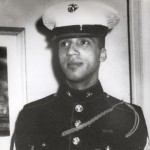
Rodney M. Davis
Sgt. - USMC
Medal of Honor
 
Rodney Maxwell Davis (April 7, 1942 - September 6, 1967) was a United States Marine who posthumously received the Medal of Honor for his heroism during the Vietnam War.

Biography

Davis was born on April 7, 1942, in Macon, Georgia to Gordon N. Davis and Ruth A. Davis. He attended elementary school and high school there and graduated from Peter G. Appling High School, May 29, 1961.

Shortly after graduation, he enlisted in the United States Marine Corps in his hometown, August 31, 1961; then reported for recruit training with the First Recruit Training Battalion Marine Corps Recruit Depot Parris Island, South Carolina. Upon completion of recruit training in December 1961, he was transferred to the Marine Corps Base, Camp Lejeune, North Carolina, and underwent Individual Combat Training with the Second Battalion, First Infantry Training Regiment, graduating the following February.

He then joined Company K, 3rd Battalion, 2nd Marines, 2nd Marine Division, FMF, at Camp Lejeune and served as a rifleman until May 1964. While stationed at Camp Lejeune, he was promoted to Private First Class, April 1, 1962, and to Lance Corporal, January 1, 1964.

Lance Corporal Davis was ordered to London, England, for a three year tour of duty as Guard with the United States Marine Detachment, Naval Activities. He was promoted to Corporal, January 1, 1966, and to Sergeant, December 1, 1966.

Ordered to the Republic of Vietnam in August 1967, he was assigned duty as a Platoon Guide with Company B, First Battalion, Fifth Marines, First Marine Division. On September 6, 1967, he was operating with his unit in the Quang Nam Province on a search and clear mission during Operation Swift, when they were attacked by a large North Vietnamese force. Elements of the platoon were pinned down in a trench line by mortars, heavy automatic and small arms fire. He went from man to man encouraging them on and also returning fire at the same time. An enemy hand grenade fell in the trenches his men were fighting from and without hesitation he threw himself upon the grenade. He saved his fellow Marines in this selfless act and thus earned the nation's highest military decoration: the Medal of Honor.

Sgt. Davis was survived by his wife, Judy P. Davis, two daughters Nichola Davis, and Samantha J. Davis-Steen, Esq.

Awards and honors

Medal of Honor citation

The President of the United States in the name of The Congress takes pride in presenting the MEDAL OF HONOR posthumously to

SERGEANT RODNEY M. DAVIS
UNITED STATES MARINE CORPS

for service as set forth in the following CITATION:

For conspicuous gallantry and intrepidity at the risk of his life above and beyond the call of duty while serving as the right guide of the Second Platoon, Company B, First Battalion, Fifth Marines, First Marine Division, in action against enemy forces in Quang Nam Province, Republic of Vietnam, on September 6, 1967. Elements of the Second Platoon were pinned down by a numerically superior force of attacking North Vietnamese Army Regulars. Remnants of the platoon were located in a trench line where Sergeant Davis was directing the fire of his men in an attempt to repel the enemy attack. Disregarding the enemy hand grenades and high volume of small arms and mortar fire, Sergeant Davis moved from man to man shouting words of encouragement to each of them firing and throwing grenades at the onrushing enemy. When an enemy grenade landed in the trench in the midst of his men, Sergeant Davis, realizing the gravity of the situation, and in a final valiant act of complete self-sacrifice, instantly threw himself upon the grenade, absorbing with his own body the full and terrific force of the explosion. Through his extraordinary initiative and inspiring valor in the face of almost certain death, Sergeant Davis saved his comrades from injury and possible loss of life, enabled his platoon to hold its vital position, and upheld the highest traditions of the Marine Corps and the United States Naval Service. He gallantly gave his life for his country.
/S/ RICHARD M. NIXON