skip to main |
skip to sidebar
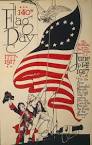
Flag Day
In the United States,
Flag Day is celebrated on June 14. It commemorates the adoption of the flag of
the United
States, which happened on that day in 1777 by
resolution of the Second Continental Congress. The United States Army also
celebrates the Army Birthday on this date; Congress adopted "the American
continental army" after reaching a consensus position in the Committee of the
Whole on June 14, 1775.
In 1916, President Woodrow Wilson
issued a proclamation that officially established June 14 as Flag Day; in August
1949, National Flag Day was established by an Act of Congress. Flag Day is not
an official federal holiday. Title 36 of the United States Code, Subtitle I,
Part A, CHAPTER 1, § 110 is the official statute on Flag Day; however, it is at
the President's discretion to officially proclaim the observance.
On June 14,
1937, Pennsylvania became the first
U.S. state to celebrate Flag
Day as a state holiday, beginning in the town of Rennerdale. New York Statutes designate the
second Sunday in June as Flag Day, a state holiday.
Perhaps the oldest continuing Flag
Day parade is in Fairfield,
Washington. Beginning in 1909 or
1910, Fairfield
has held a parade every year since, with the possible exception of 1918, and
celebrated the "Centennial" parade in 2010, along with some other commemorative
events.
Appleton, Wisconsin claims to be the oldest
National Flag Day parade in the nation, held annually since 1950 It was also
named "Most Patriotic City in America" by AmericaTheBeautiful.com
in 2008.
Quincy, Massachusetts has
had an annual Flag Day parade since 1952 and claims it "is the longest-running
parade of its kind in the nation."
The largest Flag Day parade is held annually in Troy, New York, which
bases its parade on the Quincy parade and typically draws 50,000
spectators.
In addition, the Three Oaks, Michigan Flag Day Parade is held annually on the
weekend of Flag Day and is a three-day event and they claim to have the largest
flag day parade in the nation as well as the oldest.

Memorial Day History
Three years after the Civil War ended, on May 5, 1868, the head of an
organization of Union veterans — the Grand Army of the Republic (GAR) —
established Decoration Day as a time for the nation to decorate the graves of
the war dead with flowers. Maj. Gen. John A. Logan declared that Decoration Day
should be observed on May 30. It is believed that date was chosen because
flowers would be in bloom all over the country.
The first large observance was held that year at Arlington National Cemetery,
across the Potomac River from Washington, D.C.
The ceremonies centered around the mourning-draped veranda of the Arlington
mansion, once the home of Gen. Robert E. Lee. Various Washington officials,
including Gen. and Mrs. Ulysses S. Grant, presided over the ceremonies. After
speeches, children from the Soldiers’ and Sailors’ Orphan Home and members of
the GAR made their way through the cemetery, strewing flowers on both Union and
Confederate graves, reciting prayers and singing hymns.
Local Observances Claim To Be First Local springtime
tributes to the Civil War dead already had been held in various places. One of
the first occurred in Columbus, Miss., April 25, 1866, when a group of women
visited a cemetery to decorate the graves of Confederate soldiers who had fallen
in battle at Shiloh. Nearby were the graves of Union soldiers, neglected because
they were the enemy. Disturbed at the sight of the bare graves, the women placed
some of their flowers on those graves, as well.
Today, cities in the North and the South claim to be the birthplace of
Memorial Day in 1866. Both Macon and Columbus, Ga., claim the title, as well as
Richmond, Va. The village of Boalsburg, Pa., claims it began there two years
earlier. A stone in a Carbondale, Ill., cemetery carries the statement that the
first Decoration Day ceremony took place there on April 29, 1866. Carbondale was
the wartime home of Gen. Logan. Approximately 25 places have been named in
connection with the origin of Memorial Day, many of them in the South where most
of the war dead were buried.
Official Birthplace Declared In 1966, Congress and President
Lyndon Johnson declared Waterloo, N.Y., the “birthplace” of Memorial Day. There,
a ceremony on May 5, 1866, honored local veterans who had fought in the Civil
War. Businesses closed and residents flew flags at half-staff. Supporters of
Waterloo’s claim say earlier observances in other places were either informal,
not community-wide or one-time events.
By the end of the 19th century, Memorial Day ceremonies were being held on
May 30 throughout the nation. State legislatures passed proclamations
designating the day, and the Army and Navy adopted regulations for proper
observance at their facilities.
It was not until after World War I, however, that the day was expanded to
honor those who have died in all American wars. In 1971, Memorial Day was
declared a national holiday by an act of Congress, though it is still often
called Decoration Day. It was then also placed on the last Monday in May, as
were some other federal holidays.
Some States Have Confederate Observances Many Southern
states also have their own days for honoring the Confederate dead. Mississippi
celebrates Confederate Memorial Day on the last Monday of April, Alabama on the
fourth Monday of April, and Georgia on April 26. North and South Carolina
observe it on May 10, Louisiana on June 3 and Tennessee calls that date
Confederate Decoration Day. Texas celebrates Confederate Heroes Day January 19
and Virginia calls the last Monday in May Confederate Memorial Day.
Gen. Logan’s order for his posts to decorate graves in 1868 “with the
choicest flowers of springtime” urged: “We should guard their graves with sacred
vigilance. ... Let pleasant paths invite the coming and going of reverent
visitors and fond mourners. Let no neglect, no ravages of time, testify to the
present or to the coming generations that we have forgotten as a people the cost
of a free and undivided republic.”
The crowd attending the first Memorial Day ceremony at Arlington National
Cemetery was approximately the same size as those that attend today’s
observance, about 5,000 people. Then, as now, small American flags were placed
on each grave — a tradition followed at many national cemeteries today. In
recent years, the custom has grown in many families to decorate the graves of
all departed loved ones.
The origins of special services to honor those who die in war can be found in
antiquity. The Athenian leader Pericles offered a tribute to the fallen heroes
of the Peloponnesian War over 24 centuries ago that could be applied today to
the 1.1 million Americans who have died in the nation’s wars: “Not only are they
commemorated by columns and inscriptions, but there dwells also an unwritten
memorial of them, graven not on stone but in the hearts of men.”
To ensure the sacrifices of America ’s fallen heroes are never forgotten, in
December 2000, the U.S. Congress passed and the president signed into law “The
National Moment of Remembrance Act,” P.L. 106-579, creating the White House
Commission on the National Moment of Remembrance. The commission’s charter is to
“encourage the people of the United States to give something back to their
country, which provides them so much freedom and opportunity” by encouraging and
coordinating commemorations in the United States of Memorial Day and the
National Moment of Remembrance.
The National Moment of Remembrance encourages all Americans to pause wherever
they are at 3 p.m. local time on Memorial Day for a minute of silence to
remember and honor those who have died in service to the nation. As Moment of
Remembrance founder Carmella LaSpada states: “It’s a way we can all help put the
memorial back in Memorial Day.”
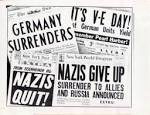
Victory in Europe
Day
8 May 1945
Victory in
Europe Day, generally known as V-E Day, VE Day or simply V Day
was the public holiday celebrated on 8 May 1945 (7 May in Commonwealth realms)
to mark the formal acceptance by the Allies of World War II of Nazi Germany’s
unconditional surrender of its armed forces. It thus marked the end of World
War II in Europe.
The term VE Day
existed as early as September 1944, in anticipation of victory. On 30 April
1945, Adolf Hitler, the Nazi leader, committed suicide during the Battle of
Berlin. Germany's
surrender, therefore, was authorised by his successor, Reichspräsident
Karl Dönitz. The administration headed by Dönitz was known as the Flensburg
Government. The act of military surrender was signed on 7 May in Reims, France
and on 8 May in Berlin, Germany.
Celebrations
Upon the defeat
of Germany,
celebrations erupted throughout the world. From Moscow
to Los Angeles,
people celebrated. In the United
Kingdom, more than one million people
celebrated in the streets to mark the end of the European part of the war. In London, crowds massed in Trafalgar Square and up the Mall to Buckingham Palace,
where King George VI and Queen Elizabeth,
accompanied by Prime Minister Winston Churchill, appeared on the balcony of the
palace before the cheering crowds. Princess Elizabeth
(the future Queen Elizabeth II) and her sister Princess Margaret were allowed to wander incognito among the crowds and
take part in the celebrations.
In the United States,
the victory happened on President Harry Truman's
61st birthday. He dedicated the victory to the memory of his predecessor, Franklin
D. Roosevelt, who had died of a cerebral hemorrhage less than a month earlier, on
12 April. Flags remained at half-mast for the remainder of the 30-day mourning
period. Truman said of dedicating the victory to Roosevelt's
memory and keeping the flags at half-mast that his only wish was "that
Franklin D. Roosevelt had lived to witness this day." Later that day,
Truman said that the victory made it his most enjoyable birthday.
Massive
celebrations also took place in Chicago, Los Angeles, Miami and
especially in New York's Times
Square.
Soviet
Victory Day
As the Soviet
representative in Reims had no authority to sign the German instrument of
surrender, the Soviet leadership proposed to consider Reims
surrender as a "preliminary" act. The surrender ceremony was repeated
in Berlin on
8 May, where the instrument of surrender was signed by supreme German military
commander Wilhelm Keitel, by Georgy Zhukov and Allied representatives. Since
the Soviet Union was to the east of Germany, it was 9 May Moscow time when the
German military surrender became effective, which is why Russia and most of the
former Soviet republics commemorate Victory Day on 9 May instead of 8 May.
Vietnam War 1975
Operation Frequent Wind begins
Operation Frequent Wind, the largest helicopter evacuation on record, begins
removing the last Americans from Saigon.
The North Vietnamese had launched their final offensive in March 1975 and the
South Vietnamese forces had fallen back before their rapid advance, losing Quang
Tri, Hue, Da Nang, Qui Nhon, Tuy Hoa, Nha Trang, and Xuan Loc in quick
succession. With the North Vietnamese attacking the outskirts of Saigon, U.S.
Ambassador Graham Martin ordered the commencement of Frequent Wind.
In 19 hours, 81 helicopters carried more than 1,000 Americans and almost
6,000 Vietnamese to aircraft carriers offshore. Cpl. Charles McMahon, Jr. and
Lance Cpl. Darwin Judge, USMC, were the last U.S. military personnel killed in
action in Vietnam, when shrapnel from a North Vietnamese rocket struck them as
they were guarding Tan Son Nhut Airbase during the evacuation. At 7:53 a.m. on
April 30, the last helicopter lifted off the rook of the embassy and headed out
to sea. Later that morning, North Vietnamese tanks crashed through the gates of
the Presidential Palace. North Vietnamese Col. Bui Tin accepted the surrender
from Gen. Duong Van Minh, who had taken over from Tran Van Huong (who only spent
one day in power after President Nguyen Van Thieu fled). The Vietnam War was
over.
Lead Story
2004
On April 29, 2004, the National World War II Memorial opens in Washington,
D.C., to thousands of visitors, providing overdue recognition for the 16 million
U.S. men and women who served in the war. The memorial is located on 7.4 acres
on the former site of the Rainbow Pool at...
American Revolution
1776
American Revolution
1776
On this day in 1776, shortly after the American victory at Boston,
Massachusetts, General George Washington orders Brigadier General Nathanael
Greene to take command of Long Island and set up defensive positions against a
possible British attack on New York City. Greene?s troops were arranged to
defend themselves against a frontal...