Easter, which celebrates Jesus Christ's resurrection from the dead, is
Christianity's most important holiday. It has been called a moveable feast
because it doesn't fall on a set date every year, as most holidays do. Instead,
Christian churches in the West celebrate Easter on the first Sunday following
the full moon after the vernal equinox on March 21. Therefore, Easter is
observed anywhere between March 22 and April 25 every year. Orthodox Christians
use the Julian calendar to calculate when Easter will occur and typically
celebrate the holiday a week or two after the Western churches, which follow the
Gregorian
calendar.
Saturday, February 27, 2016
Alexander A. Vandegrift
General Alexander Archer Vandegrift, who earned the Medal of Honor in World War II, served as the eighteenth
Commandant of the Marine Corps, from January 1, 1944 to January 1, 1948. The
general commanded the First Marine Division, Reinforced, in the battle for
Guadalcanal, and the First Marine Amphibious Corps in the landing at Empress
Augusta Bay, Bougainville, during World War II.
"With the adverse factors of weather, terrain and disease making his task a difficult and hazardous undertaking, and with his command eventually including sea, land, and air forces of the Army, Navy, and Marine Corps, Major General Vandegrift achieved marked success in commanding the initial landings of the United States Forces in the Solomon Islands and in their subsequent occupation.
"His tenacity, courage and resourcefulness prevailed against a strong, determined and experienced enemy, and the gallant fighting spirit of the men under his inspiring leadership enabled them to withstand aerial, land and sea bombardment, to surmount all obstacles and leave a disorganized and ravaged enemy.
"This dangerous but vital mission, accomplished at the constant risk of his life, resulted in securing a valuable base for further operations of our forces against the enemy."
General Vandegrift was born on March 13, 1887, in Charlottesville, Virginia. He attended the University of Virginia and was commissioned in the Marine Corps as a second lieutenant on January 22, 1909.
Following instruction as the Marine Officers' School, Port Royal, South Carolina, and a tour of duty at the Marine Barracks, Portsmouth, New Hampshire, he went to foreign shore duty in the Caribbean area, where he participated in the bombardment, assault and capture of Coyotepe in Nicaragua. He further participated in the engagement and occupation of Vera Cruz, Mexico.
In December 1914, following his promotion to first lieutenant, he attended the Advance Base Course at the Marine Barracks, Philadelphia. Upon completion of schooling, he sailed for Haiti with the First Brigade and participated in action against hostile Cacos bandits at LeTrou and Fort Capois.
In August 1916, he was promoted to captain and became a member of the Haitian Constabulary at Port Au Prince, where he remained until detached to the United States in December 1918. He returned to Haiti again in July 1919, to serve with the Gendarmerie d' Haiti as an Inspector of Constabulary. He was promoted to major in June 1920.
Major Vandegrift returned to this country in April 1923, and was assigned to the Marine Barracks at Quantico, Virginia. He completed the Field Officers' Course, Marine Corps Schools in May 1926, following which he went to the Marine Corps Base, San Diego, California, as Assistant Chief of Staff.
In February 1927, he sailed for China where he served as Operations and Training Officer of the Third Marine Brigade with Headquarters at Tientsin. He was ordered to Washington, D. C., in September 1928, where he became Assistant Chief Coordinator, Bureau of the Budget.
Following duty in Washington, he joined the Marine Barracks, Quantico, Virginia, where he became Assistant Chief of Staff, G-1 Section, Fleet Marine Force. During this assignment, he was promoted to lieutenant colonel in June 1934. Ordered to China in June 1935, Lieutenant Colonel Vandegrift served successively as Executive Officer and Commanding Officer of the Marine Detachment at the American Embassy in Peiping. He was promoted to colonel in September 1936.
Colonel Vandegrift reported to Headquarters Marine Corps, Washington, D. C., in June 1937, where he became Military Secretary to the Major General Commandant. In March 1940, he was appointed Assistant to the Major General Commandant, and the following month was promoted to brigadier general.
General Vandegrift was detached to the First Marine Division in November 1941 shortly before the outbreak of World War II. He was promoted to major general in March 1942, and in May sailed for the South Pacific area as Commanding general of the first Marine division to ever leave the shores of the United States. On August 7, 1942, in the Solomon Islands, he led ashore the First Marine Division, Reinforced, in the first large-scale offensive action against the Japanese.
In July 1943, he assumed command of the First Marine Amphibious Corps, and commanded this organization in the landing at Empress Augusta Bay, Bougainville, Northern Solomon Islands, on November 1, 1943. Upon establishing the initial beachhead, he relinquished command and returned to Washington, D. C., as Commandant-designate. On January 1, 1944, as a lieutenant general, he was sworn in as the eighteenth Commandant of the Marine Corps. On April 4, 1945, he was appointed general, with date of rank from March 21, 1945, the first Marine officer on active duty to attain four-star rank.
For outstanding services as Commandant of the Marine Corps from January 1, 1944 to June 30, 1946, the general was awarded the Distinguished Service Medal. He left active service on December 31, 1947, and was placed on the retired list, April 1, 1949.
General Vandegrift holds an honorary degree of Doctor of Military Science from Pennsylvania Military College, and honorary degrees of Doctor of Law from Harvard, Colgate, Brown, Columbia, and Maryland Universities and John Marshall College.
In addition to the Medal of Honor, Navy Cross, and Distinguished Service Medal, his decorations and Medals include: the Presidential Unit Citation with one Bronze Star, Solomon Islands, 1942; Navy Unit Commendation with one Bronze Star, Solomon Islands, 1943, and Okinawa, 1945; Expeditionary Medal with three Bronze Stars, Cuba, 1912, Nicaragua, 1912, Haiti, 1915-24, China, 1927-28; Nicaraguan Campaign Medal, Nicaragua, 1912; Mexican Service Medal, Mexico, 1914; Haitian Campaign Medal with one Star, Haiti, 1915 and 1919-20; Victory Medal with West Indies Clasp and one star, Haiti, 1918; Yangtze Service Medal, Shanghai, 1927; American Defense Service Medal, 1939-1941; Asiatic-Pacific Campaign Medal with four Bronze Stars, Solomon Islands, 1942-43; American Campaign Medal; and the World War II Victory Medal.
He has received the following foreign decorations: Haitian Distinguished Service Medal, Haiti, 1919-20; Medaille Militaire with one Silver Star, Haiti, 1920-21; Honorary Knight Commander, Military Division of the Most Excellent Order of the British Empire; Companion (Honorary) of the Military Division of the Most Honourable Order of the Bath, British Solomon Islands, 1942; Cruz de Aviacion de Primera Clase, Peruvian Government, 1944; Abdon Calderon of the 1st Class, Ecuador, 1944, Knights Grand Cross in the Order of the Orange-Nassau with Swords, Netherlands, 1945; the Order of Pao-Ting (Precious Tripod) with Special clasp, China, 1947; and the Legion of Honor (Grand Officer), France.

Friday, February 12, 2016
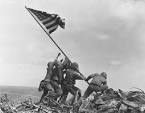
The Battle of Iwo Jima
The Battle of Iwo Jima took place in
February 1945. The capture of Iwo Jima was part of a three-point plan the
Americans had for winning the war in the Far
East.
By 1944, America and her allies in the Pacific War had the ascendancy. In the west, the Japanese were being turned back in Burma and island hopping had isolated Japanese forces in the eastern sector. Combined with the attacks on Iwo Jima, was America’s desire to finally destroy Japan’s merchant fleet so that the Japanese mainland could not be supplied from the food-rich sectors of South East Asia which Japan still had control over. Linked to this, was the destruction of Japan’s remaining industrial base by the bombing of it by the American airforce.
Iwo Jima is a very small Pacific island – just over 4.5 miles long and 2.5 miles wide which lies at the foot of the Bonin chain of islands, south of the main Japanese island of Honshu.
Despite its size, Iwo Jima was considered to have great tactical importance. There were two airfields on the island – under Japan’s control; they could be used by Japanese fighter planes to attack American bombers on their flights to Japan. Under American control, the airfields could be used as emergency landing bases for damaged airplanes in the bombing raids. They could also be used for American fighter planes to escort the bombers, as they needed smaller runways for take-off.
Knowing that the island was of such importance, the Japanese were determined to keep control of it. There were about 22,000 soldiers under the command of Lieutenant-General Kuribayashi. These men had had the time to build strong defensive positions throughout the island but especially in the north. Kuribayashi knew that his options for launching attacks were extremely limited because of the small size of the island. In fact, his options to do anything other than defend ferociously were extremely limited.
America had vast reserves at their disposal. Iwo Jima was ‘softened up’ by bombing raids for more than two months before the actual amphibious assault. For three days prior to the attack, six American battleships had launched a continuous barrage on the island. Within the region, the Americans were led by Admiral Raymond Spruance – though the overall commander of the campaign was Admiral Chester Nimitz. The landing forces were under the command of Lieutenant-General Holland ‘Howling Mad’ Smith. The bulk of the amphibious attack was done by Marines.
The first day of the landings was February 19th, 1945. The Marines took heavy casualties, as the American bombings had not been effective. What it had done was to churn up the beaches and the immediate hinterland and had given the Japanese far more opportunities to find hiding-holes for snipers. It also meant that American movement inland was hindered as the area had been so heavily bombed. A few well placed Japanese snipers could hold up an American advance for hours.
However, the Americans had cut the island in two by the end of the first day – despite taking over 2,400 casualties. On Day 2, the Marines attacked Mount Suribachi. Here they found fanatical Japanese defence and Suribachi was taken on February 23rd after three days of fighting.
Iwo Jima proved a difficult and bloody target to take – frequently the Americans only advanced at several hundred metres per day. By March 11th, the Japanese were trapped in an area around Kitano Point, the island’s most northerly extremity. By March 16th, the island was declared secure and all resistance had ceased by March 26th.
The tiny island had taken America over one month to take. The Marines lost 6,891 men killed and 18,070 wounded. Out of the 22,000 Japanese soldiers on the island, only 212 were taken prisoners. What the battle did show the Americans was how far the Japanese would go to defend their country – a decision that was to influence the use of the atomic bombs in Hiroshima and Nagasaki.
Wednesday, February 3, 2016
By Land or Sea, the Confederate States Marine CorpWas a Force to Reckon With
There has been much written about the United States Marine Corps throughout its history, yet, not much is known, let alone written, about the Confederate States Marine Corps. Historians that research the Confederate Marine Corps have to go back to the US Marine Corps for comparisons because the Confederate Marine history has deep roots with the United States Marines.
On March 16, 1861, just one month after the creation of the Confederate Provisional Government, the Navy Department was authorized to create the Confederate States Marine Corps. Initially intended to be a battalion of 6 companies commanded by a major, this organization benefited by "old corps" officers who resigned their U. S. commissions and offered their services to the South. An amendatory act was passed on May 20, 1861 to enlarge the Corps to 10 companies commanded by a colonel with an end strength of 1,072 Marines.
This is in comparison with the size of the USMC at the opening shot of the Civil War was 1,768, which included the President’s Own (Marine Band). The peak strength of the US Marines would reach 3,881 in February 1865 whereas the Confederate Marines mustered less than 600 at its zenith. Despite its relatively small size, the CSMC distinguished itself in many ways throughout the war by defending shore installations, embarking on ships, and engaging in numerous battles with enemy land forces when the need arose. Due to a lack of able-bodied seamen in the Confederate Navy, rebel Marines were called upon to maintain discipline and man the deck guns of the ship more so than in the US Marines. In addition, the CS Marines was seen as a unique organization that could be relied upon to take on special assignments when the need arose and carried out these varied duties with a high degree of success despite its small numbers.
As an interesting note, Black Americans were also employed in the Confederate Navy and Marines. The marines were a part of the Navy Department and at the time, Navy regulations authorized one black for every five whites. Dr. Edward Smith, Dean of American Studies at American University, estimates that by February 1865, 1,150 Black Americans had served in the Confederate States Navy. This number would equate to approximately 20 percent of this branch of the Confederate military. Smith is currently researching the names and compiling a list of those blacks that served in the CS Marines and is meeting with some success by looking through the pension records.
Origins of the CSMC
The bulk of the Confederate Marines officer corps were seasoned veterans from the USMC who tendered their resignations in order to offer their services for the cause of the South. Fifty-six officers were appointed to the CSMC throughout the Civil War and 19 of these were former USMC officers. An interesting note is that the Confederate Commandant was actually a former U.S. Army officer.
Col. Lloyd J. Beall, a West Point graduate, was a paymaster in the U.S. Army stationed at St. Louis, MO when he tendered his resignation and headed south. Although born at Fort Adams, RI, he was a Marylander who married the daughter of a South Carolina senator, and his loyalties were with the South. On May 23, 1861, Confederate Secretary of the Navy, Stephen R. Mallory, appointed Beall a colonel in the Confederate States Marine Corps and served in that capacity throughout the war. An administrator during the Civil War, Beall’s military knowledge and experience remained an untapped resource. Beall worked hard to have the Confederate Marine Corps receive the personnel, supplies and other benefits accorded to other branches of the military. The training of officers and enlisted Marines took place at the Marines’ barracks named Camp Beall in honor of the Commandant just a short distance to the south of Richmond at Drewry’s Bluff overlooking the James River. By the end of the war, he had succeeded in helping improve the resources available to the Confederate Marine Corps and established separate marine training camps in Charleston, South Carolina; several permanent stations on the Mississippi River and Atlantic Coast. Thanks, in part, to Beall’s efforts; the Confederate Marines gained a reputation for distinguished combat service, on the sea and land. After the Civil War, Beall lived in Richmond, Virginia, and kept most of the Confederate States Marine Corps records at his home. Much of this history, along with Beall’s personal history, was destroyed in a fire. Perhaps a final irony of Beall’s life was his death on November 10, 1887, the official birthday of the United States Marine Corps.
The organization of the CSMC into companies under the nominal control of a regimental headquarters was different from the organization of the USMC at that time. The USMC was organized under Marine barracks, and ship detachments and were sent out accordingly from those barracks near the ship’s homeport. The intent of the CSMC was to train officers and enlisted Marines at Drewry’s Bluff (similar to the USMC training at Marine Barracks, Washington DC) and then send them out to man ship detachments or “barracks” at designated ports or installations. The captains were responsible for recruiting their own companies and not until later in the war were recruiting offices established throughout the South. Initial enlistment’s were for 4 years, but later changed to 3 when recruiting goals were not met.
By late April 1861, when war was declared and new states were joining the Confederacy, Secretary of the Navy Stephen Mallory reported to President Davis that Marine Corps recruiting stations were—“looking for a few good Southern men” in the capital city of Montgomery, Alabama, and in the bustling port of New Orleans, Louisiana. Most of the new detachments went first to Pensacola, Florida, where Southern forces were besieging a Union garrison in Fort Pickens on Santa Rosa Island. On July 26, 1861, the 300 man Marine battalion, made up of 3 companies, was attached to the 3d Brigade of the Army of Pensacola and a fourth company of 150 Marines was sent to New Orleans in defense of the harbor. Upon the Federal bombardment of Pensacola, the battalion transferred its companies piecemeal to Virginia and completed the movement, with a small detachment remaining at Mobile, AL around February 24,1862. Other Marine detachments served with the Naval battery attached to General Johnston’s army at Centreville, Virginia, and scattered stations along the coast of Georgia and South Carolina.
During the Union offensives in the spring of 1862, the Southern Marines were involved in a battle on the Mississippi River. The Yankees sailed up the Mississippi on April 24th to challenge Forts Jackson and St Phillip with their ocean going warships; they ran into John Mitchell’s River Defense Flotilla, which included the ship, McRae and her Marine detachment. During the swirling river fight, the McRae took on four enemy vessels at once, including the USS Iroquois which suffered twenty-six casualties among her own Marines. This was the first face to face fight between Northern and Southern Marines.
The bulk of the CSMC remained in the Richmond area at Camp Beall on Drewry’s Bluff and at the Navy Shipyard, Norfolk, VA with smaller units deploying to Wilmington, NC; Charleston, SC; and Savannah, GA. From these locations, rebel Marines formed ship detachments and embarked on numerous vessels that included ironclads and cruisers to prey upon northern shipping. The largest Marine contingent that served onboard a ship was the detachment of 55 officers and men who served on the ironclad CSS Virginia. Marines served aboard the CSS Sumter, CSS Shenandoah (recruited from Australian stowaways while visiting Melbourne, Australia), CSS Alabama, CSS Atlanta (rechristened the Tallahassee and also known as the Olustee), CSS Tennessee, CSS Chickamauga, and the gunboat Gaines, to name a few.
Roles of Marines
CS Marine regulations prescribed that Marines could be employed on board ship as gun crews under their own officers, or even as individuals assigned to regular gun crews. But such assignments were to be made only in case of necessity. It was pretty well understood that many Marines had been trained as artillerists and many served in heavy fortifications manning the shore battery guns guarding Wilmington, Charleston, Savannah, New Orleans, and Mobile to name a few major Southern ports.
As the war progressed, another function of the Marines developed. Confederate Marines were used as a type of Special Forces unit. Confederate Marines were called upon many times for special missions such as the plan to capture Federal ironclads anchored off of Charleston Harbor in 1863. This plan called for the Marines to board the ships at night and disable the engine by dropping sulfur, gunpowder, and wet blankets down the smokestack. Once this was completed, the Marines would wait for the gassed victims to emerge and surrender or die from suffocation. Training was conducted and the Marines were ready, yet the Union armada of nine ironclads that sailed into Charleston Harbor on April 6, 1863 received such a terrible shelling that the fleet withdrew and the mission was scrubbed when the threat vanished.
In July of 1864, General Robert E. Lee devised a plan where a battalion of Marines were to slip through the Federal naval blockade and make a amphibious landing at Point Lookout above Washington D. C. to free the Confederate Prisoners of War there. This was to be done in support of General Jubal Early’s raid on Washington. The force was led again by Thomas S. Wilson and included 2nd Lt. Henry H. McCune of Missouri. But because of fear that the plan was leaked out, the ships carrying the Marines were called back and the mission aborted.
Exploits of the CSMC
One of the most notable events of the war involved a duel off Hampton Roads, VA between the Union ironclad Monitor and the Confederate ironclad Virginia on March 8-9, 1862. Marines manned several guns during the standoff and performed well enough to be mentioned in Admiral Buchanan’s report where he commended the coolness of the Marines that manned the guns on the Virginia. Although the Marines were not able to perform their traditional role of sniping and boarding enemy ships or repelling boarders, their skill and daring behind the deck guns was exemplary and showed that the Marines were an integral part of the ship’s complement. This type of action would be repeated throughout the Confederate States Navy wherever Marines were present. The Marines redeployed to Drewry’s Bluff when the Virginia was trapped in the James River by Union forces and she was scuttled to prevent her capture.
After the Virginia had to be destroyed on May 11, 1862, her crew transferred to the shore defenses at Drewry’s Bluff on the James River just in time to battle five Union warships which attempted to ascend the river to Richmond. On May 15,1862, a Federal flotilla comprised of the ironclad USS Monitor, the armor-plated gunboat USS Galena, and the wooden gunboats Aroostook and Port Royal tried unsuccessfully to run the gauntlet at Drewry’s Bluff. Along with the accurate cannon fire, Marine sharpshooters were very effective as evidenced by wounding the commanding officer of the USS Port Royal and trading heavy volume of fire with the U.S. Marines embarked on the ships. The Marine battalion at Drewry’s Bluff would remain until fighting late in the war caused them to retreat with General Robert E. Lee’s army.
Another interesting footnote of history involves Confederate Marine Sgt. George Stephenson of the infamous commerce raider CSS Sumter. After a long career the CSS Sumter was abandoned at Gibraltar and a small force was left behind including a Marine Guard commanded by Sgt. Stephenson. The Commanding officer Midshipman Williams Andrews was killed in October 1862 by a seaman and Sgt. Stephenson became the only Marine Federal or Confederate to command a ship of war in the War for Southern Independence.
The Eclipse of the CSMC
In December 1864, the Confederate Marines were caught up in Sherman’s capture of Savannah, Georgia. Most of the station’s Marines went ashore to reinforce the army and remained with the army in its retreat to the north. With the South’s Atlantic ports now falling like dominoes, Fort Fisher was next. After a three-day bombardment, Union Forces were landed on January 15, 1865, and grappled with the defenders at close range. They overran the main fort, capturing Battery Buchanan and the Mound Battery. In true Marine Corps tradition, the fifty-man company fought a bayonet last stand from gun to gun until they were “all killed or captured.”
The Marines who came north from the fallen port cities took post in Richmond’s shore defenses, and were overlooked during the first evacuation. Along with displaced and shipless seamen, the Marines were organized into a naval brigade under the overall command of Captain Tucker, CSN, and attached to Custis Lee’s division of the Army of Northern Virginia. On April 6, 1865, the Yankees overwhelmed the Confederate rearguard, General Ewell’s Corps, at Sayler’s Creek, but the Marine brigade fought so hard that the enemy bypassed them to pursue other routed army units. The core of this brigade was a battalion of some 200 marines. It was reported that the Marine battalion fought courageously in savage hand-to-hand combat with the 37th Massachusetts and 121st New York Regiments in rain-swollen marshland and repulsed the attack of the Federals. The 37th Massachusetts regimental commander credited his unit’s use of Spencer repeating rifles as the only reason they were able to avoid disaster at the hands of the Marines. Fifteen minutes after General Ewell surrendered, the brigade was still firing away. The remnants of the naval brigade were surrounded at day’s end. Only after massed batteries were trained on the Marines did they yield forcing Capt Tucker to surrender his forces. Their conduct in the face of disaster was worthy of the Corp’s heritage.
The remains of the Confederate Marines withdrew to Appomattox and surrendered with General Lee on April 9, 1865. Twenty-nine Marines were present when General Lee surrendered Appomattox Court House. 1stLt Richard Henderson (former USMC Commandant Gen. Archibald Henderson’s son) was the senior Marine present on that day when the Confederate Corps capitulated alongside the Army of Northern Virginia. The last Confederate Marines to surrender in the war were north of at Hanna Bluff, Al, just north of Mobile on May 10,1865.
Conclusion
By coincidence, the first recruiting for the Confederate Marine Corps in 1861 and the last surrender of an organized unit of the Corps took place in Alabama. Based on the principle laid down by USMC Commandant Gene Archibald Henderson prior to the Civil War, the USMC was to be ready to respond instantly to any emergency. To the credit of Col. Beall and his experienced officers, the CSMC abided by the same principle. With a battalion-sized unit close to the CSMC Headquarters, the Marines were ready and capable of responding in short notice to emerging threats and special operations. Despite its small size, the CSMC distinguished itself numerous times and was constantly called upon and in demand not only by the Confederate Navy, but by the Army as well. On four separate occasions throughout the war, the CSMC received official thanks from the Confederate Congress. Even in the Confederacy’s waning days, the rebel Marines did not give up without a fight. One Union soldier after the Battle of Sayler’s Creek stated; “Those Marines fought like tigers and against odds of at least ten to one.” Whether on land or sea, the rebel Marines fought with valor and tenacity only expected of an elite fighting force.
The CSMC, although short lived, carried itself notably and could be seen as an implicit extension of the principle of a force in readiness as espoused long before the Civil War.
The Marines of the South were the foundation of the Marine Corps we know today.
Subscribe to:
Posts (Atom)