Thursday, July 19, 2007

George C. Scott, Actor and United States Marine
George Campbell Scott (October 18, 1927 - September 22, 1999) was a stage and film actor, director, and producer. He was best known for his Academy Award winning portrayal of General George S. Patton,Jr. in the film Patton, as well as for his flamboyant performance as General Buck Turgidson in Stanley Kubrick's Dr. Strangelove or: How I Learned to Stop Worrying and Love the Bomb.

Early life
Scott was born in Wise, Virginia to George Dewey Scott (1902-1987) and Helena Agnes Scott (1904-1935), the only son and younger of their two children. His mother died just before his eighth birthday, and he was raised by his father, an executive at the Buick Motor Company.

As a young man, Scott's original ambition was to be a writer like his idol, F. Scott Fitzgerald, and while in high school, he wrote many short stories, none of which were ever published. As an adult, he tried on many occasions to write a novel, but was never able to complete one to his satisfaction. When asked by an interviewer in later life which contemporary novelists he admired, he replied, "I stopped reading novels when I stopped trying to write them."

Scott joined the U.S. Marine Corps, serving from 1945 until 1949, and was assigned to the prestigious 8th and I Barracks in Washington, D.C. In that capacity, he served as a ceremonial guard at Arlington National Cemetery and taught English literature and radio speaking/writing at the Marine Corps Institute. Scott later said that his duties at Arlington led to his drinking. After his military service, Scott enrolled in the University of Missouri, where he majored in journalism and then became interested in drama; he left college after a year to pursue acting.

Broadway and film career
Scott began his acting career on Broadway, and achieved critical acclaim portraying the prosecutor in The Andersonville Trial by Saul Levitt. This was based on the military trial of the commandant of the infamous Civil War prison camp in Andersonville, Georgia. Scott's performance earned him a mention in Time magazine as a rising young actor of great intensity. In 1970 Scott directed a highly acclaimed television version of this same play. It starred William Shatner, Richard Basehart and Jack Cassidy who was nominated for an Emmy award for his performance as the defense lawyer in this production.

In 1963, Scott was top billed in the critically acclaimed CBS hour-long drama series East Side, West Side he and co-star Cicely Tyson played urban social workers. Perhaps too gritty and stark for 1963, the show lasted only one season.

Scott also won an Obie Award for his performance as Richard III for the New York Shakespeare Festival, a performance one critic said was the "angriest" Richard III of all time.

Scott won wide public recognition in the film, Anatomy of a Murder in which he played a wily prosecutor opposite Jimmy Stewart as the defense attorney. Scott was nominated for an Academy Award for best supporting actor; when he was notified of the nomination, he called the Academy Awards a "meat parade" or "meat race". He said, "Actors are the world's oldest, underprivileged minority - looked upon as nothing but buffoons, one step above thieves and charlatans. These award ceremonies simply compound the image for me."

Scott's most famous early role was in Dr. Strangelove or: How I Learned to Stop Worrying and Love the Bomb where he played the part of General "Buck" Turgidson. It is revealed on the DVD documentary that after having shot many takes of any given scene, Stanley Kubrick would frequently asked Scott to redo it in an "over the top" fashion. Kubrick would then proceed to use this version in the final cut, which Scott supposedly resented. However, Kubrick did earn Scott's respect on this film, since by that time, Scott was an accomplished chess player. The cast and crew noted they would often play chess between takes, and Kubrick was the only person who could routinely beat Scott.

Scott's portrayal of the swaggering and controversial General Patton in the 1970 film Patton has become, to many, his most iconic performance. Scott had researched extensively for the role, studying films of the general and talking to those who knew him. Having declined an Academy Award nomination for his appearance in the 1961 film, The Hustler, Scott returned his Oscar for Patton, stating in a letter to the Academy that he didn't feel himself to be in competition with other actors. However, also regarding this second rejection of the Academy Award, Scott famously said elsewhere, "The whole thing is a goddam meat parade. I don't want any part of it." In the mid-80s, Scott reprised his role as Patton for a television movie. At the time that sequel was aired, Scott mentioned in a TV Guide interview that he had verbally told the Academy to donate his Oscar to the Patton Museum; since the instructions were never put in writing, it was never delivered.

In 1971, Scott gave two more critically acclaimed performances, as a de facto Sherlock Holmes in They Might Be Giants and as an alcoholic doctor in the black comedy The Hospital Despite his repeated snubbing of the Academy, Scott was again nominated for Best Actor for the latter role. Scott excelled on television that year as well, appearing in an adaptation of Arthur Miller's The Price, an installment of the Hallmark Hall of Fame anthology. Scott was nominated for, and won, an Emmy Award for his role, which he accepted. Scott's reasoning for keeping an Emmy after rejecting an Oscar was believed to be due to the fact that the Emmy Award winners were chosen by blue-ribbon panels of experts, while Academy Award winners were chosen by the entire Academy membership. The actor also starred in the popular 1980 horror film The Changeling with Melvyn Douglas. He received the Canadian Genie Award for Best Foreign Film Actor for his performance.

In 1984, Scott was cast in the role of Ebenezer Scrooge in a television adaptation of A Christmas Carol Critics and the public alike praised his performance. Some have said his Scrooge ranks alongside Alastair Sim's portrayal. He was nominated for an Emmy Award for the role.

In 1990, he voiced the villain Smoke in the TV special Cartoon All-Stars to the Rescue, where his character was alongside popular cartoon characters like Bugs Bunny. That same year, he voice acted the villain Percival McLeach in the Disney film, The Rescuers Down Under.

Scott had a reputation for being moody and mercurial while on the set. "There is no question you get pumped up by the recognition," he once said, "Then a self-loathing sets in when you realise you're enjoying it." He said he'd seen a psychiatrist four times, "I kept laughing. I couldn't get serious. If it helps you, it helps you. If standing on your head on the roof helps you, it helps you - if you think so." There is a famous anecdote that one of his stage co-stars, Maureen Stapleton, told the director of Neil Simon's Plaza Suite "I don't know what to do, I am scared of him." The director, Mike Nichols, replied, "My dear, everyone is scared of George C. Scott!"

Scott's favorite film actress was Bette Davis, whom he called "my bloody idol."

Private life
Scott was married five times:
Carolyn Hughes (1951?1955) (two daughters, Michelle and Victoria)
Patricia Reed (1955?1960) (two children, Mathew, and actress Devon Scott who was born on November 29, 1958).

The Canadian-born actress Colleen Dewhurst, by whom he had two sons, writer Alexander Scott, and actor Campbell Scott. Dewhurst nicknamed her husband "GS". (1960?1965)

He remarried Colleen Dewhurst on 4 July 1967, but divorced for a second time on 2 February 1972.

The American actress Trish Van Devere on September 4, 1972, with whom he starred in several films, including the supernatural thriller The Changeling (1980). They were estranged at the time of his death.

George C. Scott died on September 22, 1999 at the age of 71 from a ruptured abdominal aortic aneurysm. He was interred in the Westwood Village Memorial Park Cemetery in Westwood, California. He is buried next to Walter Matthau, in an unmarked grave.

My Memories of
Marine Sergeant George C. Scott
By Major Bob Morrissey USMC (Ret)
September 24, 1999

The author of this memoir is Maj Bob Morrissey, USMC (Ret), who was a Marine Corps combat correspondent and Public Affairs Officer, who was Commandant of the Marine Corps Gen Wallace M. Greene, Jr.'s personal public affairs officer. I asked Mo if it would be OK to forward this to the WWII list because there have been a number of posts re/Scott in recent days. I hope you all approve. BMF
__________________________________


George C. "Patton" Scott, who died at age 71, and I were good friends and frequent liberty buddies while serving together as three-stripers at the Washington Marine Barracks from 1946--1948.

George and I were both instructors at the Marine Corps Institute, then an accredited academic correspondence school for Marines. I instructed first-year college journalism, English grammar, and authored a new MCI course in photo journalism. George instructed English literature and Radio Speaking and Writing.

Because he marched with the grace of a gazelle, he was designated guidon bearer for the elite Barracks ceremonial company. I marched immediately behind him as company right guide , ever-failing to emulate his awesome ballbearing strides. We marched in rain, snow, and Washington heat in many military funerals at Arlington cemetery--sometimes two or three a day--as well as in presidential inaugural parades and other special ceremonial occasions in DC. This was in addition to our regular MCI duties. George found funeral details distasteful to him. He became very depressed when witnessing families and relatives mourning the deaths of their Marines.

George was quoted several times in his life-after the Corps as saying that the Marine Corps made him an alcoholic. One late night when I was standing barracks duty, I was summoned to Brinkley's, the Marines' watering hole across from the gate, by a fellow sergeant moonlighting as a bouncer. "Get him out of here before he tears up the joint and gets in trouble." I proceeded to wrestle a very intoxicated George back across the street to the barracks. On such occasions, he was always beligerent, if not sometimes mean.

As I was half carrying, half dragging his six foot frame down the barracks arcade enrote to his squad bay, he suddenly paused, looked me straight in the eye, and declared in very slurred , but insistent voice: "You know, Mo, someday I'm gonna be a goddamned great actor."

"Yeah, right George," I responded, humoring him, "you'll be that." However, he didn't hear me. He had unceremoniously passed out cold on the arcade bricks.

I believe George was falling off the wagon before reporting to DC. It got worse with time, caused by his deep disappointment that he had not seen combat as a Marine in WWII. He had enlisted in the Corps as WWII was coming to an end, specifically choosing to be a Marine because he sincerely believed the Corps would get him into combat before the war ended, something fiercely important to him. Didn't happen. He cried on my shoulder about this.

He liked being a Marine, and was a good one, but he was never destined to make a career of it., returning to civilian life in 1949 upon expiration of his enlistment. He never considered his duties at 8th &I very exciting. He had other fish to fry. For a time he wanted to be a journalist, but becoming an actor eventually consumed him.

He was known to be irascible (as a Marine and his life thereafter). He did not suffer fools (of any rank) lightly, nor did he make friends easily, but he was very loyal to those to befriend. I don't recall him ever dating while on duty at the barracks. When we pulled liberty together (before I became married to Mary Jane), we usually went off post to a deli to enjoy our favorite sandwiches with Coke or coffee and a lot of enjoyable conversation, a blend of serious and humorous. Because I did not imbibe(at the time), he spared me from joining him when he set out to hang one on at Brinkley's. (He did, however, count on me to rescue you him on occasion.)

After watching Marine Sergeant George Scott become Gen. George Patton on the screen, I sought George's address and/or phone number through the studio. I was told to send my communication through the studio and they would ensure he would receive it. My short note read: "Dear George, you were right. You are a goddamned great actor! Semper Fi, Mo."

No reply. He was never big on maintaining friendships. His ambitions were elsewhere. Could be he may not have remembered his declaration that night in the barracks arcade so my message may not have made sense to him. I did have witnesses, however. Two noncom buddies coming off liberty were moving to help me get George to bed and heard his remark.

Here is an additional chapter to Bob Morrissey's recollection of his time and service with George C. Scott. BMF

MO REMINISCES
I'm motivated to write this, in part, because I'm venting. I'm much disturbed to read/hear the extensive news mediacoverage of the death of Sergeant George C. Scott, USMC, almost consistently reporting that Scott spent his four years in the Corps "doing nothing but burial details," which alegedly caused him to become an alcoholic. Not!

During the period we served together ('46--'48)--remember this was more than 50 years ago when we were just escaping from our teens--there existed two major entities at the Washington Marine Barracks: an MCI detachment, composed mostly of enlisted Marine instructors (some with one or more degrees) responsible for the operation of the "school," and a Barracks detachment, responsible for maintenance and security of the Barracks. Marines assigned to one or other detachment did not get along well--ever!

For instance. The barracks detachment had absolute control of the barracks main gate. Marines were required to be spit-and-polish, as they are today, when departing the compound (no civilian clothes authorized in those days). Enter a nasty little (5'6") Barracks corporal named Holmes who actually volunteered for Barracks gate sentry duty from 1600 to midnight EVERYDAY!

When MCI Marines sought to exit the barracks, Holmes subjected us to detailed personnel inspections, including haircuts and fingernails. If Holmes could not see his reflection mirrored in your shoes, you were denied exit. Dull brass belt buckles, wrinkled uniforms, etc. were unacceptable. (Holmes was really disappointed when we were issued Eisenhower jackets --sans belts.)

When MCI types eventually got fed up with Holmes antics, we addressed our grievances to our MCI detachment officers, who insisted that Holmes was just doing his duty in a military manner at all times, then snickered among themselves. The Barracks CO, A pastured colonel, avoided any involvement.

One evening when George and I were heading out on liberty, Holmes made an extra effort to find reason to deny us exit, at which time George drew himself up to his 6-foot tallness, glowering down at the arrogant little corporal, and bellowed in his familiar raspy voice: "I thought we were all Marines, one for all, corporal. Someday soon we're going to meet outside the gate and have a very serious discussion about your biased, chicken-shit antics." Holmes read George loud and clear, paled, and waved us through the gate. (As reported in the media, quick-tempered George suffered five broken noses in his lifetime, never shying from a physical confrontation whether under the influence or not. (I never witnessed a broken Scott nose on my watch.)

George was hardly alone in his dislike for Holmes and very seriously intended he would meet him outside the barracks some night and "straighten out the son-of-a-bitch." A number of MCI Marines, including me, intended to share in the "discusssion." Holmes knew it and never again left the barracks while he was serving as a gate sentry. Never! He also became aware that he was under constant surveillance within the barracks by MCI Marines just waiting for him to go out the gate.

It was for the Barracks detachment to provide personnel for "burial details" --pallbearers, firing squads, buglers, etc. Not a piece of cake, especially for pallbearers, who were required to carry coffins in a military manner from the caisson on a nearby road to the grave site, often up and down formidable hills. Occasionally, they had a helluva time avoiding dropping the coffin and having to frantically chase it down a hill. More so in rain or snow.

In addition to serving as correspondence school instructors--on which we spent more of our time than marching--MCI Marines were responsible for what was usually referred to as "funeral" details (as distinguished from "burial" details), as well as many other cewremonial events requiring marching Marines. We did considerable early am. marching and close order drilling on the barracks parade ground while the Commandant of the Marine Corps was consuming his breakfast in the Home of the Commandants facing the parade ground. Afterwards, stowing our rifles, we were expeditously bussed from southeast Washington to an old, dilapidated (some swore it was condemned) once-upon-a-time school house. Barracks mess personnel would show about noon each workday with "gourmet" field rations to ensure us a hearty "catered" hot lunch.

We were crammed into large departmental classrooms with dangerously worn wooden floors and furnished with ancient WWI-vintage wooden desks butted up against each other. George and I wrer "butted. " allowing us to communicate with each other "very quietly" when so inclined. Our department was supervised by two civilian PhDs, both of whom had once been short-term Marines and were now final reviewers of our work. Their spacious office was in one end of the adjoing cloak room.

The school's furnace rarely functioned adequately, if at all, during cold weather, frequently requiring us to perform our duties wearing our lined field jackets--and gloves! We had no typewriters (nor computers, of course), so all our necessary comments on, and critiques of, written lessons received regularly from U. S. Marines all over the world were reviewed and graded by us in gloved longhand. If you wanted hot coffee, you brought your own thermos. Sometimes we got so cold that there were vailed threats of burning down the old schoolhouse just so we could get warm.

To set the record straight, neither George nor I were ever assigned to "burial" details, as is being reported. Just periodic "funeral" details--which none of us enjoyed. And none of us ever imbibed on duty. (the famous Washington Marine Barracks didn't even have a slopshute.)

So much for reminisces. RIP "goddamned great actor." Glad you chose to be a Marine and to have known you. You will not be forgotten.



Wednesday, July 18, 2007

Tyrone Power, U. S. Marine and Actor
Tyrone Edmund Power, Jr. (May 5, 1914 - November 15, 1958), usually credited simply as Tyrone Power and known sometimes as "Ty Power", was an American film and stage actor who appeared in dozens of films from the 1930s to the 1950s, often as a swashbuckler or romantic lead, in such movies as The Mark of Zorro. The Black Swan, Prince of Foxes. The Black Rose and Captain from Castile. Though famous for his dark, classically handsome looks that made him a matinee idol from his first film appearance, Power was not just handsome but very versatile. He played a wide range of roles, from a protagonist with a darker side to light romantic comedy. In the 1950s, he began placing limits on the number of movies he would make in order to have time for the stage. He received his biggest accolades as a stage actor in John Brown's Body and Mister Roberts. He died of a heart attack at the age of 44.

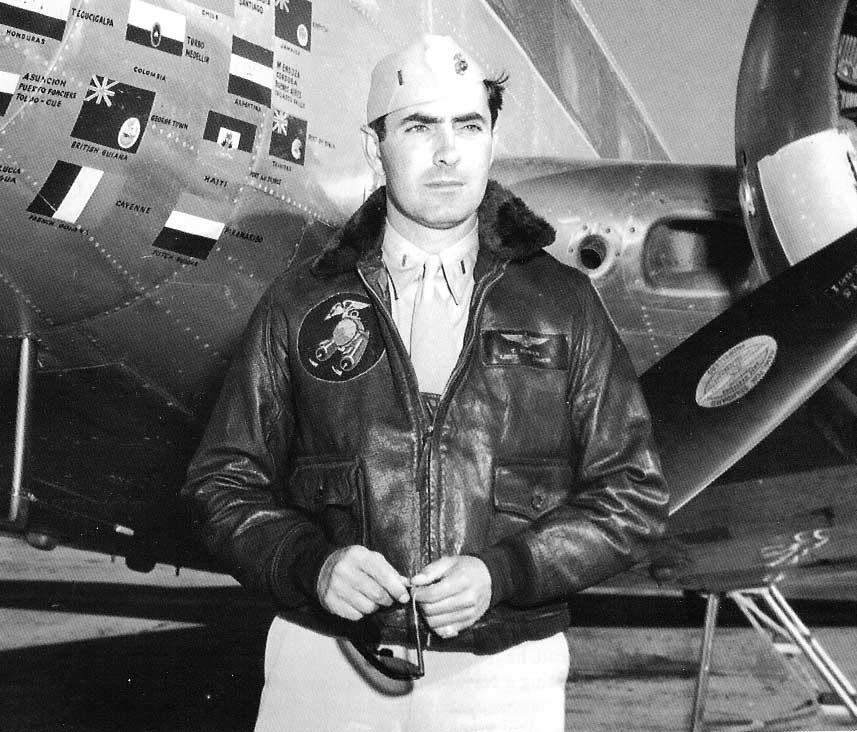
Tyrone Power's career was interrupted in 1943 by military service. He reported to the U.S. Marines for training in late 1942, but he was sent back, at the request of 20th Century-Fox, to complete one more film, 1943's Crash Dive a patriotic war movie. He was credited in the movie as Tyrone Power, U.S.M.C.R., and the movie served as much as anything as a recruiting film.

In August 1942, he enlisted in the Marine Corps. He attended boot camp at Marine Corps Recruit Depot San Diego and then attended Officer's Candidate School at Marine Corps Base Quantico, where he was commissioned a Second Lieutenant on June 2, 1943. Because he had already logged 180 solo hours as a pilot prior to enlisting in the Marine Corps, Tyrone Power was able to go though a short, intense flight training program at Naval Air Station Corpus Christi, Texas, where he earned his wings and was promoted to First Lieutenant. Power arrived at Marine Corps Air Station Cherry Point, North Carolina in July, 1944 and was assigned to VMR-352 as an R5C copilot. The squadron moved to Marine Corps Air Station El Toro in California in October 1944. Power was reassigned to VMR-353 and joined them on Kwajalein in February 1945. He flew cargo and wounded Marines during the Battle of Iwo Jima and the Battle of Okinawa. He returned to the United States in November 1945 and he was released from active duty in January 1946. He was promoted to Captain in the reserves on May 8, 1951 but was not recalled for service for the Korean War.

Tuesday, July 17, 2007

Hugh O'Brian, former Marine
When we think of Hugh O'Brian, we think of him as a actor - that he was. We also think of him as a lawman, Wyatt Earp, that he portrayed on television for several years. However, we never think of him as a former United States Marine. O'Brian enlisted in the Marine Corps at age 17 in 1943. At age 18, he became the youngest (DI) drill instructor in the history of the United States Marine Corps.

Motion picture and television star Hugh O'Brian has mastered his craft across the entire spectrum of show business. But with all his success, he has never lost sight of his civic and philanthropic responsibilities that his chosen field offers to those who choose to use their popularity to motivate others for a worthy cause. He has reinvested his good fortune in many ways to help others, working tirelessly to develop projects to benefit young people.

He is the Founder and Chairman of the Executive Committee of Hugh O'Brian Youth Leadership (HOBY), organized by Hugh in 1958 "to seek out, recognize and develop leadership potential in high school sophomores". HOBY is endowed in perpetuity by Mr. O'Brian's will. In 1964, he also set up the Hugh O'Brian Acting Awards at UCLA, designed to bring recognition to the outstanding young actors and actresses at the University, which was held annually for 25 years.
Born in 1925 in Rochester, New York, Mr. O'Brian's introduction to diversification came early. He attended high school at New Trier in Winnetka, Illinois; Rossevelt Military Academy in Aledd, Ill. and Kemper Military School in Booneville, Missouri. In high school, his sports activities were diversified among football, basketball, wrestling and track, winning letters in all four sports. After a semester at the University of Cincinnati with studies charted toward a law career, Mr. O'Brian, at 17, enlisted in the Marine Corps in 1943. He became the youngest drill instructor in the Marine Corps' history at age 18, and during his four-year service won a coveted Marine Fleet appointment to The United States Naval Academy. After passing the entrance exams, he declined the appointment at the end of World War II, intending to enroll at Yale to study law.

After serving four years, and receiving his honorable discharge from the Marine Corps in 1947, Mr. O'Brian went to Los Angeles where he planned to earn money for his Yale tuition. He met Ruth Roman and Linda Christian, very successful actresses at the time, who introduced him to a "little theatre" group. When a leading man became ill, Mr. O'Brian agreed to substitute. Originally, he felt the experience might be helpful in his law career; however, he got such good reviews in Somerset Maugham's play "Home and Beauty," that he decided to enroll at UCLA, and continue his little theater appearances as an avocation while continuing his quest for a college education. About a year later in 1948, Ida Lupino saw one of his performances and signed him to portray his first starring role in the film "Young Lovers" which Ms. Lupino directed. This brought him a contract with Universal Studios. During his first year under contract he enrolled at Los Angeles City College and managed to amass 17 college credits in addition to making five pictures at Universal.

Mr. O'Brian left Universal after three years to star in three films for 20th Century Fox, "There's No Business Like Show Business", "Broken Lance" and "White Feather", along with numerous television shows. The "big break" in his career came in 1954, when he was chosen to portray the legendary lawman Wyatt Earp on TV. Shortly after the series debuted in September, 1955 as the "first adult western", it became the top-rated show on TV and Mr. O'Brian became a much-discussed talent. During its seven-year run, "Wyatt Earp" always placed in the top five T.V. shows in the nation. In 1972-73 he starred in another TV series "Search".

Mr. O'Brian has also had an illustrious career in the theatre. He starred on Broadway in "Destry Rides Again," "First Love," and in the first Broadway revival of "Guys and Dolls." He also starred in the national company of "The Music Man", "Mr. Roberts", "Cactus Flower," "The Odd Couple," "The Tender Trap," "A Thousand Clowns," and "Plaza Suite." He has guest-starred on numerous television shows including the Today Show, the Larry King and Jim Bohannan Shows, Charlie Rose's Nightwatch and The Pat Sajak Show.

More recent TV/film credits include "The Shootist" (John Wayne's last film), "Killer Force," "Game of Death," "Twins" (with Arnold Schwartzenegger), and numerous appearances on TV's "Fantasy Island," "Love Boat," "Paradise," "Gunsmoke II", "Murder, She Wrote", "L.A. Law", and a Kenny Rogers Gambler IV movie "The Luck of the Draw: The Gambler Returns", a 1994 return to the famous Wyatt Earp role, "Wyatt Earp: Return to Tombstone", received great reviews and the honor of being the highest rated TV show of the week.

In 1958, Mr. O'Brian was privileged to spend nine inspirational days with Nobel Laureate and great humanitarian Dr. Albert Schweitzer, at his clinic in Africa. Dr. Schweitzer's strong belief that "the most important thing in education is to teach young people to think for themselves" impressed O'Brian. Two weeks after his return to the United States, he put Schweitzer's words into action by forming The Hugh O'Brian Youth Leadership (HOBY). Its format for motivation is simple: bring a select group of high school sophomores with demonstrated leadership abilities together with a group of distinguished leaders in business, education, government and the professions, and let the two interact. Using a question-and-answer format, the young people selected annually by over 14,500 public and private high school to attend a HOBY Leadership Development Seminar held each spring in their state get a realistic look at what makes America's Incentive System work, thus better enabling them "to think for themselves."

HOBY Leadership Development Seminars take place in all 50 states (38 states hold two to five seminars per state, because of the large number of schools in that state), as well as in Canada, China, Israel and Mexico. All public and private high schools in the United States receive HOBY's nomination materials by the end of September each year. All lOth-graders are eligible, and encouraged to apply. More than 14,500 "outstanding" high school sophomores, selected to represent as many schools, will attend these three to four day educational seminars annually. All HOBY programs are coordinated by volunteers. Service organizations such as the Kiwanis, General Foundation of Women's Clubs, the National Management Association, Optimists, Lion's Club and Jaycees are the backbone of this volunteer effort. Mr. O'Brian himself sets a positive example by donating 70 hours a week or more to HOBY.

One boy and girl is selected from each of the local 90 HOBY Leadership Seminar sites held each spring to represent their state at HOBY's "Superbowl", the eight-day, all-expense paid World Leadership Congress (WLC), which is held annually in a major U.S. city, and is coordinated by a prestigious university. In addition, outstanding 10th graders from 45 countries are selected to represent their part of the world committee to attend the annual HOBY WLC program. The cultural differences that exist between countries of the world are explored in friendship by the American sophomores and their international counterparts. The HOBY experience is truly an inspirational event of a lifetime for these young future leaders.

HOBY is a non-profit organization and is funded solely through the private sector. It does not seek support from any government source. HOBY is one of America's best examples of a "private sector" initiative.
HOBY's goal is not to teach these future leaders "what to think, not how to think", and what the thinking process is. In essence, HOBY is a dream, which through Mr. 0'Brian's dedication and vision, along with the steadfast efforts of his army of 4,000 dedicated volunteer supporters, has become a reality to benefit mankind. Following is Hugh O'Brian's credo:

The Freedom to Choose:
"I do NOT believe we are all born equal. Created equal in the eyes of God, yes, but physical and emotional differences, parental guidelines, varying environments, being in the right place at the right time, all play a role in enhancing or limiting an individual's development. But I DO believe every man and woman, if given the opportunity and encouragement to recognize their potential, regardless of background, has the freedom to choose in our world. Will an individual be a taker or a giver in life? Will that person be satisfied merely to exist or seek a meaningful purpose? Will he or she dare to dream the impossible dream?

I believe every person is created as the steward of his or her own destiny with great power for a specific purpose, to share with others, through service, a reverence for life in a spirit of love."

In 1972, Mr. 0'Brian was awarded one of the nation's highest honors, the Freedom Through Knowledge Award, sponsored by the National Space Club in association with NASA.

In 1973, he was honored by the American Academy of Achievement.

In 1974, he was awarded the George Washington Honor Medal, highest award of the Freedom Foundation at Valley Forge, as well as the coveted Globe and Anchor Award from the Marine Corps.

In 1976, the Veterans of Foreign Wars honored him with an award. He is the recipient of the AMVETS Silver Helmet Award, and in 1983, the National Society of Fund Raising Executives (NSFRE) honored him with their premier award for overall philanthropic excellence as a volunteer, fundraiser and philanthropist. This is the only time one individual has received the award in all three categories. Notre Dame honored him with the first "Pat 0'Brian Memorial Award" in 1984. That same year, The Family Counseling Service honored Mr. O'Brian with its first National Family of Man Award.

In 1989, he received the 60th Annual American Education Award presented by the American Association of School Administrators. This award is the oldest and most prestigious award that the education profession bestows.

On June 2, 1990, the Los Angeles Business Council awarded Mr. O'Brian its sixth Lifetime Achievement Award, in recognition of outstanding achievement working within the framework of the American Free Enterprise System.

In 1992, Mr. O'Brian was inducted into the Great Western Performers Hall of Fame, and in 1993, Mr. O'Brian was awarded the Lifetime Achievement Award from the Franklin Mint.

In 1994, Mr. O'Brian was awarded the Freedoms Foundation's Private Enterprise Exemplar medal, in 1995 the American Celtic Globe Humanitarian Award from the Ireland Chamber of Commerce, in 1995 the Epsilon Sigma Alpha (ESA, Int.) Vision Award, and in 1997 the KNX Newsradio Man of the Year Award and the Central City Association of Los Angeles' Treasures of Los Angeles Award.

In 1998, Mr. O'Brian was given the highest civilian honor from the United States Department of the Navy, the Meritorious Public Service Citation. He was also one of the year 2000 recipients of the National Ethnic Coalition of Organizations Foundation (NECO) Ellis Island Medal of Honor Award. In March, 2002, he will receive the Distinguished Service Award, the highest award given by NAASP/teh National Association of Secondary School Principals.

Mr. 0'Brian has been awarded honorary degrees by seven prestigious institutions of higher learning. He has received honorary Doctorates of Humane Letters from Saint Mary of the Plains College in Kansas,Lebanon Valley College in Pennsylvania, Bloomsburg University in Bloomsburg, Pennsylvania and Green Mountain College, Poultney, Vermont, as well as an honorary Doctor of Laws degree from Saint John's University in New York. In the summer of 1987, Mr. O'Brian was presented with an honorary Doctor of Public Services degree from the University of Denver, and in the summer of 2000, her was presented with an honorary Doctor of Public Service from The George Washington University in Washington, D.C.. Each university honored Mr. 0'Brian for the outstanding work he has undertaken on behalf of youth throughout the United States and the world.

Mr. O'Brian lives in a hilltop home overlooking Beverly Hills. Diverse as ever, his sporting activities include sailing, scuba diving and swimming.

Friday, July 13, 2007

Lou Diamond, USMC Hero
Master Gunnery Sergeant Leland "Lou" Diamond USMC (May 30, 1890 - September 20, 1951) is famous within the US Marine Corps as the classic example of the "Old Breed" - tough, hard-fighting career Marines who served in the Corps in the years between World War I and World War II.

Early years
Diamond was born May 30, 1890, at Bedford, Ohio. He enlisted at age 27, and though older than most recruits, the difference never was noticeable. Diamond enlisted in the Marine Corps at Detroit, Michigan, 25 July 1917, listing as his former occupation "railroad switchman."

Character
Because of the incredible voice, which matched his 5-foot, 11-inch, 200-pound frame, Diamond was once dubbed "The Honker". Many of his comrades at Guadalcanal considered him "a human air-raid warning system."

Diamond lived informally, going hatless and wearing dungarees practically everywhere. He even accepted one of his decorations in dungarees. Self-confidence, even cockiness, was one of his outstanding characteristics. He considered anybody with less than ten years in the Corps a "boot". While he bawled out recruits who sometimes instinctively saluted him, he frequently failed, himself, to salute less than a field grade officer.
Diamond rejected opportunities to apply for a commission — that is, become an officer — saying "nobody can make a gentleman out of me."

World War I
As a corporal in January 1918, he shipped out from Philadelphia aboard the USS Von Steuben bound for Brest, France. He saw action with the famous 6th Marines in the battles at Chateau Thierry, Belleau Wood, the Aisne-Marne, St. Mihiel and the Meuse-Argonne. Promoted to the grade of sergeant, he marched to the
Rhine with the Army of Occupation. At war's end, "Mr. Leatherneck" returned to America, and received an honorable discharge.

Inter-war period
Railroading, and civilian life in general, did not suit him, and on 23 September 1921, Diamond re-enlisted.
"Mr. Marine" itched for more action and he soon got it in Shanghai, with Company M, 3rd Battalion, 4th Marine Regiment. But the Sino-Japanese controversy, in Diamond's opinion, was "not much of a war," and on 10 June 1933, he returned to the United States, disembarking from the USS Henderson (AP-1) at Mare Island, California. By then he was a Gunnery Sergeant.
Diamond returned to Shanghai with his old outfit, the 4th Marines, ten months later; was transferred to the 2nd Marines in December, 1934; and returned to the States in February, 1937. Two years after his promotion to Master Gunnery Sergeant on 10 July 1939, he was assigned to the Depot of Supplies at Philadelphia to help design a new infantry pack.

World War II
Following the Japanese attack at Pearl Harbor, Diamond shipped out to Guadalcanal with Company H, 2nd Battalion, 5th Marines, 1st Marine Division, arriving at the beaches 7 August 1942. He was then 52 years old.

Though not a "spit-and-polish" Marine, Diamond prove himself an expert with both 60- and 81mm mortars, his accurate fire being credited as the turning point of many an engagement in the Pacific during World War II. Among the many fables concerning his Guadalcanal service is the tale that he lobbed a mortar shell down the smoke stack of an off-shore Japanese cruiser. It is considered a fact, however, that he drove the cruiser from the bay with his harassing "near-misses".

General A.A. Vandegrift, Commander of the 1st Marine Division, and later Commandant of the Marine Corps, wrote a letter of commendation that states in part:

To every man in your company you were a counselor, an arbiter ofdisputes, and an ideal Marine. Your matchless loyalty and love of the Marine Corps and all it stands for, are known to hundreds of officers and men of this Division, and will serve as an inspiration to them on all the battlefields on which this Division may in the future be engaged.

After two months on Guadalcanal, physical disabilities dictated his evacuation by air against his wishes. He was moved to the New Hebrides and later to a hospital in New Zealand, where he somehow acquired orders to board a supply ship for New Caledonia. There a friend ordered him back to Guadalcanal — the supposed location of his old outfit. Upon his arrival, however, Diamond discovered that the 1st Marine Division had shipped out to Australia, a distance of over 1,500 miles. Diamond made the trip, without orders, by bumming rides on planes, ships and trains.

But Diamond was destined to see no more combat. On 1 July 1943, he disembarked from the USS Hermitage (AP-54) at San Pedro, California, and twelve days later was made an instructor at the Recruit Depot, Parris Island, South Carolina. He was transferred to Camp Lejeune on 15 June 1945, and joined the 5th Training Battalion with the same duties.

Retirement
Diamond retired on 23 November 1945, and returned to his home in Toledo, Ohio. His death at the Great Lakes, Illinois, Naval Training Center Hospital, September 20, 1951, was followed by a funeral, with full military honors, at Sylvania, Ohio.

The Philippine-American actor Lou Diamond Phillips was named after him by his father, a Marine.