Friday, May 18, 2007

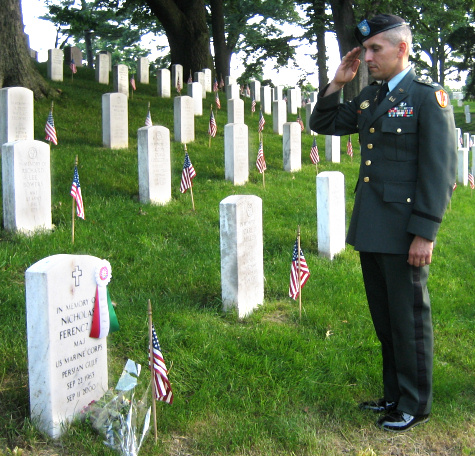
Memorial Day

Since the last Memorial Day, we have had 1,835 brave military American men and women killed in George W. Bush Iraq Civil War. As of May 26, 2007, a total of 3,455 American heroes have been killed in that war. We also have had 25,549 American casulties in Iraq, some with no legs, arms, eyes, etc., a war that is not winnable under Bush, the lunatic leadership. It should never had been fought.

Memorial Day, originally called Decoration Day, is a day of remembrance for those who have died in our nation's service. There are many stories as to its actual beginnings, with over two dozen cities and towns laying claim to being the birthplace of Memorial Day. There is also evidence that organized women's groups in the South were decorating graves before the end of the Civil War: a hymn published in 1867, "Kneel Where Our Loves are Sleeping" by Nella L. Sweet carried the dedication "To The Ladies of the South who are Decorating the Graves of the Confederate Dead" (Source: Duke University's Historic American Sheet Music, 1850-1920). While Waterloo N.Y. was officially declared the birthplace of Memorial Day by President Lyndon Johnson in May 1966, it's difficult to prove conclusively the origins of the day. It is more likely that it had many separate beginnings; each of those towns and every planned or spontaneous gathering of people to honor the war dead in the 1860's tapped into the general human need to honor our dead, each contributed honorably to the growing movement that culminated in Gen Logan giving his official proclamation in 1868. It is not important who was the very first, what is important is that Memorial Day was established. Memorial Day is not about division. It is about reconciliation; it is about coming together to honor those who gave their all.

Memorial Day was officially proclaimed on 5 May 1868 by General John Logan, national commander of the Grand Army of the Republic, in his General Order No. 11, and was first observed on 30 May 1868, when flowers were placed on the graves of Union and Confederate soldiers at Arlington National Cemetery. The first state to officially recognize the holiday was New York in 1873. By 1890 it was recognized by all of the northern states. The South refused to acknowledge the day, honoring their dead on separate days until after World War I (when the holiday changed from honoring just those who died fighting in the Civil War to honoring Americans who died fighting in any war). It is now celebrated in almost every State on the last Monday in May (passed by Congress with the National Holiday Act of 1971 (P.L. 90 - 363) to ensure a three day weekend for Federal holidays), though several southern states have an additional separate day for honoring the Confederate war dead: January 19 in Texas, April 26 in Alabama, Florida, Georgia, and Mississippi; May 10 in South Carolina; and June 3 (Jefferson Davis' birthday) in Louisiana and Tennessee.

In 1915, inspired by the poem "In Flanders Fields," Moina Michael replied with her own poem:
We cherish too, the Poppy red,
That grows on fields where valor led,
It seems to signal to the skies
That blood of heroes never dies.
She then conceived of an idea to wear red poppies on Memorial day in honor of those who died serving the nation during war. She was the first to wear one, and sold poppies to her friends and co-workers with the money going to benefit servicemen in need. Later a Madam Guerin from France was visiting the United States and learned of this new custom started by Ms.Michael and when she returned to France, made artificial red poppies to raise money for war orphaned children and widowed women. This tradition spread to other countries. In 1921, the Franco-American Children's League sold poppies nationally to benefit war orphans of France and Belgium. The League disbanded a year later and Madam Guerin approached the VFW for help. Shortly before Memorial Day in 1922 the VFW became the first veterans' organization to nationally sell poppies. Two years later their "Buddy" Poppy program was selling artificial poppies made by disabled veterans. In 1948 the US Post Office honored Ms Michael for her role in founding the National Poppy movement by issuing a red 3 cent postage stamp with her likeness on it.

Traditional observance of Memorial day has diminished over the years. Many Americans nowadays have forgotten the meaning and traditions of Memorial Day. At many cemeteries, the graves of the fallen are increasingly ignored, neglected. Most people no longer remember the proper flag etiquette for the day. While there are towns and cities that still hold Memorial Day parades, many have not held a parade in decades. Some people think the day is for honoring any and all dead, and not just those fallen in service to our country.
There are a few notable exceptions. Since the late 50's on the Thursday before Memorial Day, the 1,200 soldiers of the 3d U.S. Infantry place small American flags at each of the more than 260,000 gravestones at Arlington National Cemetery. They then patrol 24 hours a day during the weekend to ensure that each flag remains standing. In 1951, the Boy Scouts and Cub Scouts of St. Louis began placing flags on the 150,000 graves at Jefferson Barracks National Cemetery as an annual Good Turn, a practice that continues to this day. More recently, beginning in 1998, on the Saturday before the observed day for Memorial Day, the Boys Scouts and Girl Scouts place a candle at each of approximately 15,300 grave sites of soldiers buried at Fredericksburg and Spotsylvania National Military Park on Marye's Heights (the Luminaria Program). And in 2004, Washington D.C. held its first Memorial Day parade in over 60 years.

To help re-educate and remind Americans of the true meaning of Memorial Day, the "National Moment of Remembrance" resolution was passed on Dec 2000 which asks that at 3 p.m. local time, for all Americans "To voluntarily and informally observe in their own way a Moment of remembrance and respect, pausing from whatever they are doing for a moment of silence or listening to 'Taps."

The Moment of Remembrance is a step in the right direction to returning the meaning back to the day. What is needed is a full return to the original day of observance. Set aside one day out of the year for the nation to get together to remember, reflect and honor those who have given their all in service to their country.

But what may be needed to return the solemn, and even sacred, spirit back to Memorial Day is for a return to its traditional day of observance. Many feel that when Congress made the day into a three-day weekend in with the National Holiday Act of 1971, it made it all the easier for people to be distracted from the spirit and meaning of the day. As the VFW stated in its 2002 Memorial Day address: "Changing the date merely to create three-day weekends has undermined the very meaning of the day. No doubt, this has contributed greatly to the general public's nonchalant observance of Memorial Day."

On January 19, 1999 Senator Inouye introduced bill S 189 to the Senate which proposes to restore the traditional day of observance of Memorial Day back to May 30th instead of "the last Monday in May". On April 19, 1999 Representative Gibbons introduced the bill to the House (H.R. 1474). The bills were referred the Committee on the Judiciary and the Committee on Government Reform.

To date, there has been no further developments on the bill. Please write your Representative and your Senators, urging them to support these bills. You can also contact Mr. Inouye to let him know of your support.

Thursday, May 17, 2007

USMC Aviation History

Marine 1st Lt. Alfred A. Cunningham, Naval Aviator No. 5 and the first Marine pilot.

The Marine Corps has forged a winning team with its air power and ground forces.

One hundred years ago, Orville and Wilbur Wright took turns guiding their wood and fabric Flyer over the dunes of Kitty Hawk, N.C. Just over five years later, the Navy had made up its mind to acquire flying machines. Unfortunately, the then-Secretary of the Navy stated, "The department does not consider that the development of the aeroplane has progressed sufficiently at this time for use in the Navy."

The Navy persisted, and by 1912 had four aviators on its rolls. Aviation pioneer Glenn Curtiss was training pilots and developing flying boats here in San Diego. Daring pilots were making carrier landings and take-offs and learning to drop bombs on ships and trenches.

On May 22, 1912, Marine Corps 1st Lt. Alfred A. Cunningham reported for flight training. He soloed after only two hours and 40 minutes of instruction (in a Wright Bros. Model B-1), and became Naval Aviator No. 5. In his honor, May 22 has become the official "date of birth" of Marine Corps aviation.

When the United States joined World War I in 1917, the Marines Corps had just five aviators and 30 enlisted men, including Cunningham. At war’s end, Marine aviation included 282 officers and 2,180 enlisted men. Marine aviators won two Medals of Honor during World War I.

Marines learned close ground support while fighting rebels in Nicaragua, again earning awards for bravery, including the Medal of Honor for close air support.

The sudden immersion of the United States in World War II found the Marines on the front lines, defending Wake Island against a better-equipped, more-experienced Japanese force. Marine aviators led the attack in the famous Battle of Midway, an American victory despite high losses to pilots and aircraft. Marines ended World War II with 125 aces and eight Medals of Honor. The Marines’ F4-U Corsair had become famous as a symbol of Marine Corps ground support and air superiority in the Pacific.

The Marines continued their close relationship of air and ground forces in Korea, deploying jet aircraft and helicopters for the first time while still making excellent use of the legendary Corsair. The introduction of helicopters in combat increased mobility in rugged terrain and, combined with field hospitals, greatly reduced the number of combat deaths in the field.

The 1960s found Marines fighting communism in the swamps and jungles of Vietnam while at the same time pioneering America’s entry into space. The first U.S. combat troops brought into this Southeast Asian conflict, American Marines landed at Da Nang in 1965, supported by F-4B Phantom IIs and A-4D Skyhawks. From Hue to Chu Lai to Khe Sanh, Marines on the ground depended on their "Flying Leathernecks." And in 1962, Marine Corps Col. John Glenn became the first American astronaut to orbit the earth, a voyage lasting less than five hours. (In 1998, Glenn returned to space as the oldest American to do so, with 144 orbits over nine days.)

Marines have deployed to many exotic locations, from operations in Grenada and Panama to the protection of American Embassies under attack around the world, before being called upon in Operation Desert Storm, Operation Enduring Freedom, and, most recently, Operation Iraqi Freedom.

These operations were supported by USMC F/A-18 Hornets (refueled in flight by the Marine Corps's own KC-130 tankers), AV-8B Harriers, and squadrons of rotary-wing aircraft (including the CH-46, CH-53E, UH-1N and AH-1W).

As America moves into the 21st century, newer, more modern technology is moving into the air, with the tilt-wing MV-22 Osprey and Joint Strike Fighter concepts soon to join our armed forces. But, certainly, one thing that will never change is the United States Marine Corps partnership between those on the ground and those in the sky.

Tuesday, May 15, 2007

John Gunn, Col. USMCR (Ret.)
Happy Birthday!


Colonel Gunn will celebrate his 76th birthday on May 17. This gung ho United States Marine retired at Coronado, Calif., at age 52 in 1983. Gunn is a member of the Marine Corps Combat Correspondents Assn., 2nd Marine Division Assn., Marine Corps Intelligence Assn., Marine Corps Aviation., Marine Corps Heritage Foundation, Marine Corps League, Naval Aviation Museum Foundation and LST-325. He also is author of two 1992 Marine football books, "The Old Core" and "(Quite A Few Good Men." From his Gulf Breeze, Fla. home, Gunn writes a weekly sports column, "Once A Marine" that he sends via email to thousands of fans and several newspapers around the country.

This is a piece that Gunn wrote in 2003. Sonny Franck joins Marino and Winslow in football game. The picture you see is George "Sonny" Franck.


Posted: Aug 26, 2003
By John Gunn

There were a lot of little kids running around the Gridiron Plaza in South Bend, Ind., that Saturday afternoon, though some were disguised in older bodies.


Take 84-year-old George "Sonny" Franck, for instance. Memories of his glory days as a running back at the University of Minnesota (1938-40) are still fresh in his mind, if not in his legs. A two-way star for the Golden Gophers, Marine vet Franck was limited to offensive work as a receiver in the flag football game, reported the South Bend Tribune.

He was involved in five plays for the victorious West team, narrowly missing passes twice after 20-yard "sprints'' and having a sure two-point conversion snatched out of his hand by TE Kellen Winslow (Missouri), also inducted into the College Football Hall of Fame.

QB Dan Marino (Pittsburgh), OG Reggie McKenzie (Michigan), TB Napoleon McCallum (Navy) and S Ronnie Lott (USC) were among other Hall of Fame inductees playing in the flag football game.

"I HAVEN'T RUN since I was 65 and my legs feel like it,'' Franck said with a smile on his face. "There's no way I was going to pass this up. It's part of what makes this weekend special.''

Franck even tried sneaking onto the field for one defensive play on the final drive of the game, but teammates convinced to keep his seat on the bench, said the Tribune.

"If I'm here to play, I'm going to play both,'' Franck said, remembering the logic of the olden days. "There were some passes I really should have caught, but it was great to be involved.''

Franck and others also instructed many youngsters in the Youth Football Clinic that Saturday sponsored by the College Football Hall of Fame. They also signed autographs for two hours.

Only a few of the 24 new Hall of Famers have been involved in Notre Dame games, and just two, Lott and Franck, have played in Notre Dame Stadium.

Lott was on USC teams (1977-80) that won three times against the Irish, but Franck was on a Minnesota team in 1938 that lost to Elmer Layden's Irish, 19-0, in the last game between the Gophers and Notre Dame.

FRANCK AND HIS former coach Bernie Bierman, a WW I and WW II Marine vet, have less than fond memories of the 1938 Notre Dame visit. The Gophers dominated the Irish that day, rolling up rushing and passing yardage. But a fumble recovery and pass interceptions did the Gophers in. Navy vet Lou Zontini's 84-yard run and two lefty Bob Saggau passes accounted for the three Irish scores. Franck and Saggau would be '42 teammates at NAS Corpus Christi.

Years later, Bierman was on a media visit to the Irish practice field and recalled, "I can't even stand to look at that stadium. It was one of my most embarrassing losses."

Franck was only a sophomore and barely remembered, even though he was from the same hometown as Layden -- Davenport, Iowa. What Franck can remember more vividly were his days in the Marine Corps as a fighter pilot.

The Japanese did shoot down Franck to cost the U.S. one plane, but there were a half-dozen others that were involved in Franck's many crashes, the Tribune said. In the process of fighting the Japs, Franck was awarded nine battle stars.

"Did you shoot down any planes?" Franck was asked. With a twinkle in his eye, he fired back, "No, but I think I did hit one of our own!"

AFTER ACTION IN battles of the Pacific, they sent him into the invasion of Iwo Jima.

When shot down, it took two Navy planes and a destroyer to rescue Franck after his fighter was shot down off Wojte, a Japanese-held base in the Marshall Islands. He was forced to make a water landing near the enemy-held island when heavy anti-aircraft fire damaged his engine in a strafing run, UPI reported.

A Navy Catalina flying boat came to the rescue despite heavy, rolling seas. Gliding along at low speed just above the water, the plane was hit by a huge swell and split open. The six crew members of the Catalina escaped onto a life raft and, like Franck, were rescued.

An American destroyer standing by eight miles off the scene dispatched a whaleboat, which was guided to the stranded men by a Navy Ventura search plane.

While at Minnesota, Franck teamed with another Hall of Famer, Bruce Smith, to help the Gophers to an 8-0 national championship in 1940 and finished third in the Heisman Trophy balloting behind Tom Harmon and John Kimbrough. He played quarterback, safety, kick and punt returner and punter as well as sharing the primary tailback role.

Franck, chosen on 22 first-team All-America teams and Big Ten 60-yard indoor dash champion, won the Big Ten Medal for Scholarship and Athletics and was MVP in the 1941 College All-Star Game against the Chicago Bears at Soldier Field, where he signed up to serve in WW II.

Like top players and veterans, Franck also moved into pro football, playing at least parts of four seasons with the New York Giants. Now almost 85, Franck earns a small NFL pension and is even trimmer than in playing days, said the Tribune.

FRANCK ALMOST ENDED up with the Chicago Rockets in the All-American Football Conference, but owner John Keeshin, a trucking executive, reneged on a $200-a-month off-season contract, and Franck then hooked up with the Giants for pro days. His top contract called for a mere $700 a game for the 12-game schedule.

"I get more from my pension than I did as a player," he beamed. Franck had played briefly for MCAS El Toro in 1945 before his military discharge after almost four years of duty. Keeshin did sign Coach Dick Hanley and 17 players from the 1944 and '45 El Toro teams for the Rockets.
***
Nine players and coaches from NCAA Divisions I-AA, II, III and the NAIA also were enshrined by the College Football Hall of Fame, including tight end Dwayne Nix (Texas A&M-Kingsville) and late tackle Calvin Roberts (Gustavus Adolphus, Pendleton 1947, tryouts with the Giants and Eagles).

Nix a three-time All-American (1966-68), played for NAS Pensacola in 1969. He served as a Marine aviator in Vietnam and Desert Storm and is a retired Marine Reserve colonel.

Among those to be inducted in December is Coach Hayden Fry, a Marine vet.
***
Gridiron heroes of the past also were honored on new postage stamps unveiled in South Bend. The 37-cent stamps recall the exploits of Walter Camp, Marine vet Ernie Nevers (Stanford), Harold "Red" Grange and Bronko Nagurski.
***
The Marines now have 45 in the Football Hall of Fame, including Alex Agase (Illinois, Purdue V-12), Harry Agganis (Boston Univ.), Harold Ballin (Princeton), Bert Baston (Minnesota), Cliff Battles (West Virginia Wesleyan), Ron Beagle (Annapolis), Gen. John Beckett (Oregon), Angelo Bertelli (Notre Dame), Charlie Conerly (Mississippi), Bob Dove (Notre Dame), Steve Eisenhauer (Annapolis), Chalmers "Bump" Elliott (Purdue V-12, Michigan), Hugh Gallarneau (Stanford), Paul Governali (Columbia), Pat Harder (Wisconsin), Bob Herwig (California), Ed Hart (Princeton), Elroy "Crazylegs" Hirsch (Wisconsin, Michigan V-12), Weldon Humble (Rice, Southwestern Louisiana V-12), Eddie LeBaron (Pacific)

Bob MacLeod (Dartmouth), Eddie Mahan (Harvard), Jim Martin (Notre Dame), Thurman McGraw (Colorado A&M), Ed Molinski (Tennessee), Ernie Nevers (Stanford), Leo Nomellini (Minnesota), Bob Peck (Pittsburgh), Arthur Poe (Princeton), Jack Riley (Northwestern), J.D. Roberts (Oklahoma), Dave Schreiner (Wisconsin) (KIA on Okinawa), Jim Weatherall (Oklahoma), Art Weiner (North Carolina), Gen. Mike Wilson (Lafayette), Alvin "Moose" Wistert (Boston Univ., Michigan).

Coaches: Bernie Bierman, Vince Dooley, "Navy Bill" Ingram, Chuck Klausing, Tuss McLaughry, John Ralston.

John Gunn of Gulf Breeze, Fla., an independent journalist, turns out a weekly column about Marines and Marine veterans in sports. It is e-mailed (bcc) to 4,100 Marines, veterans, bases, commands, media, university presidents, pro & college coaches, athletics directors, HqMC, CentCom, 59 generals, etc.

Saturday, May 12, 2007

James Terry Conway

34th Commandant of the Marine Corps (2006 - present)

Place of birth Walnut Ridge, Arkansas
Allegiance USMC
Years of service 1970 - present
Rank General
Commands 3rd Battalion 2nd Marines
The Basic School
1st Marine Division
I Marine Expeditionary Force
Commandant of the Marine Corps
Battles/wars Operation Desert Storm
Operation Iraqi Freedom
* Operation Vigilant Resolve
Awards Defense Distinguished Service Medal (2)
Navy Distinguished Service Medal
Legion of Merit

James Conway is a General in the United States Marine Corps. On November 13, 2006, General Conway became the 34th Commandant of the Marine Corps. Conway was previously the Director of Operations (J-3) on the Joint Staff. Conway is most well known as the Commanding General of the 1st Marine Expeditionary Force from 2002 through 2004 taking part in the 2003 invasion of Iraq and also Operation Vigilant Resolve in Fallujah, Iraq.

James Conway was born in Walnut Ridge, Arkansas. He graduated from Roosevelt High School in St. Louis, Missouri and then attended Southeast Missouri State University where he was a member of the Sigma Phi Epsilon Fraternity, graduating in 1969. He was commissioned as an infantry officer in 1970. His first assignment was command of a rifle platoon with 3rd Battalion, 1st Marines out of Camp Pendleton. He also served as the Battalion's 106mm recoilless rifle platoon commander. Later he served as Marine Executive Officer aboard the aircraft carrier USS Kitty Hawk.

After graduating with honors from career-level officer school, Conway commanded two companies in the 2nd Marine Regiment's Operations and Security section, later commanding two companies at Marine Basic School. He then went on to serve as operations officer for the 31st Marine Amphibious Unit, with sea duty in the western Pacific and in contingency operations off Beirut, Lebanon.

Returning to the U.S., Conway was assigned as Senior Aide to the Chairman of the Joint Chiefs of Staff, serving two years in that capacity. After graduating from top-level officer training, again with honors, he took command of 3rd Battalion, 2nd Marines, and commanded the Battalion Landing Team in its eight-month deployment to Southwest Asia during Desert Storm.

After the war he was promoted to colonel, and assigned command of The Basic School. Promoted to Brigadier General in December 1995, he again was assigned to the JCS. After being promoted to Major General, he served as commander of the 1st Marine Division and as Deputy Commanding General of Marine Forces Central. He was promoted to Lieutenant General and assumed command of 1st Marine Expeditionary Force (I MEF) on November 16, 2002. He commanded I MEF during two combat tours in Iraq. General Conway had 60,000 troops under his command, comprised of U.S. Marines, soldiers, sailors, and British forces. In the book The Iraq War, Conway was described as, "big, buff, well read and well educated.....he represented all that was best about the new United States Marine Corps, which General Al Gray as the commandant had set up.

Lt. Gen. Conway responding to questions at a Pentagon briefing, June 2006.In a press interview on May 30, 2003, General Conway was questioned about the failure at that point to locate weapons of mass destruction in Iraq. He replied, in part:

"It was a surprise to me then, it remains a surprise to me now, that we have not uncovered weapons...It's not for lack of trying. We've been to virtually every ammunition supply point between the Kuwaiti border and Baghdad, but they're simply not there....What the regime was intending to do in terms of its use of the weapons, we thought we understood—or we certainly had our best guess, our most dangerous, our most likely courses of action that the intelligence folks were giving us. We were simply wrong. But whether or not we're wrong at the national level, I think, still very much remains to be seen."

On June 13, 2006, LtGen Conway was nominated by President George W. Bush to become the 34th Commandant of the Marine Corps.[5]; the nomination was confirmed by the Senate on August 2, 2006.

Conway is sworn in by Gen. Peter Pace, Chairman of the Joint Chiefs of Staff, on November 13, 2006.On November 13, 2006, LtGen Conway was promoted to his current rank at the Marine Barracks in Washington D.C. (8th and I) and became General James Conway, 34th Commandant of the Marine Corps.

Conway has been decorated for service, to include the Defense Distinguished Service Medal (with one bronze oak leaf cluster), Legion of Merit, Defense Meritorious Service Medal, Meritorious Service Medal (with two gold award stars), Navy Commendation Medal, Navy Achievement Medal and Combat Action Ribbon. He is married to the former Annette Drury and has three children.